
Guest Posting for SaaS Companies: Publisher Selection and Campaign Planning
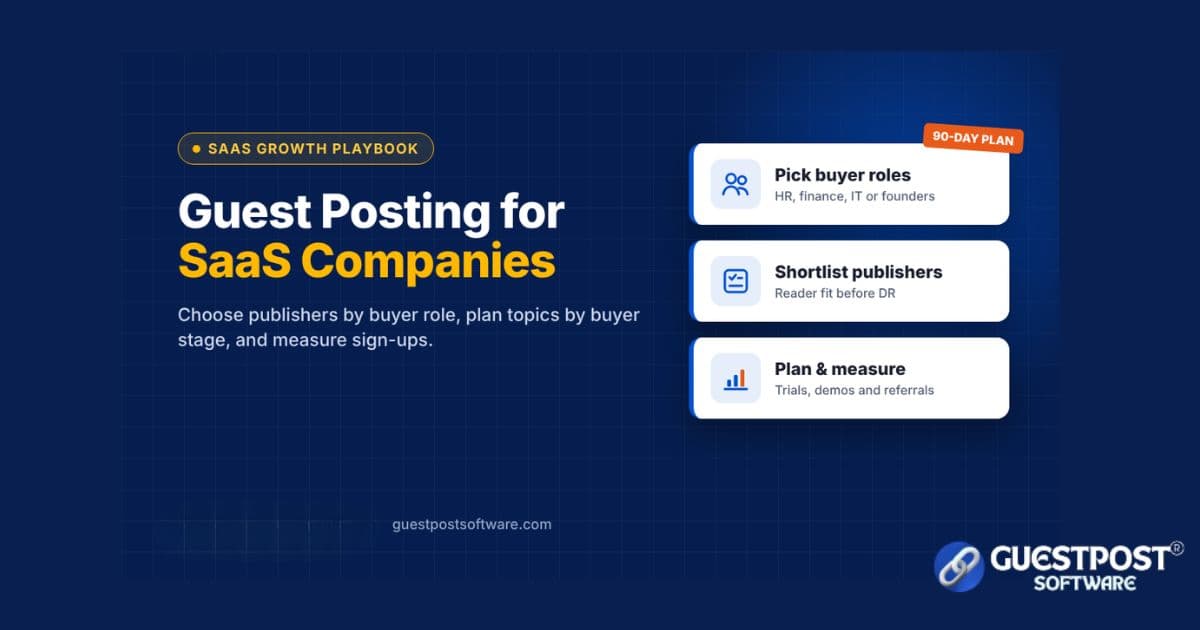
Guest posting works for SaaS companies when each article reaches a specific buyer role on a publication that role already reads. It fails when the plan starts with domain metrics instead of the customer. A DR 70 general business site may reach millions of readers and still send almost no one who would ever start a tria…
Guest posting works for SaaS companies when each article reaches a specific buyer role on a publication that role already reads. It fails when the plan starts with domain metrics instead of the customer. A DR 70 general business site may reach millions of readers and still send almost no one who would ever start a trial.
SaaS also has its own challenges. Several people often share one buying decision, sales cycles can run for months, and the product may be new enough that buyers don't yet search for it by name. A campaign has to account for all three.
This guide covers how to choose publishers for a SaaS audience, how to plan topics around buyer stages, and how to measure results beyond traffic. A worked example runs through the main steps.
How SaaS Guest Posting Differs
Three traits of SaaS buying change how you should plan guest posts.
Several people shape one purchase
A payroll tool may be used by an HR executive, approved by a finance head, and checked by IT for security. Each reads different publications. One article on a general business blog rarely reaches all three. Instead, plan separate articles for separate roles, each on a site that role trusts.
The sales cycle is long
A mid-market buyer may read about a problem in January, compare tools in March, and sign in June. That means the article a buyer reads first is rarely the one that converts. Guest posts often work as early touchpoints that make your brand familiar before the buyer searches for a solution.
Product-led and sales-led products need different goals
Product-led SaaS (self-serve sign-up, free trial or freemium): articles should lead readers to a free template, calculator, or trial page they can use straight away.
Sales-led SaaS (demos, annual contracts): articles should build credibility and lead to deeper content such as a buyer's guide, a benchmark report, or a case study.
For example, a note-taking app with a free plan can link a productivity article straight to its sign-up page. An enterprise compliance platform would do better linking to a downloadable audit checklist, because few readers book a demo from one article.
Publisher Selection for SaaS
Start with the buyer role, then find the publications that role reads. Domain metrics come last.
Publisher types that suit SaaS
Publisher type | Who reads it | Good article angle | Example |
|---|---|---|---|
Role-specific blogs (HR, finance, marketing, IT) | Practitioners and team leads | Practical how-to with a tool-neutral method | "How to Run a Payroll Audit Before Year-End" on an HR blog |
Industry trade sites | Decision-makers in one vertical | Industry-specific problem and fix | "Reducing Inventory Errors in Multi-Warehouse Retail" on a retail ops site |
Startup and founder publications | Founders of small companies | Lessons, setup guides, cost breakdowns | "What a 15-Person Startup Spends on Software in Year One" |
Developer and technical blogs | Engineers who evaluate tools | Tutorials, integration walk-throughs | "Sending Webhook Alerts to Slack in Under 20 Lines" |
Productivity and remote-work sites | End users across roles | Workflow tips and templates | "A Weekly Planning Template for Remote Teams" |
Partner and integration blogs | Users of a related tool | Joint use cases | A CRM vendor's blog featuring how its users connect your tool |
SaaS-specific vetting checks
On top of the usual checks (steady traffic, real authors, topical focus), look for these:
Reader role match. Read five recent articles and ask who they were written for. "Small business owners" and "HR managers at 200-person companies" are different audiences.
Geography and market. A UK compliance tool gains little from a site whose readers are mostly in the US, even if the topic matches.
Competitor presence. If competitors already publish there, the audience is likely right. If the site is full of competitor sponsored posts, though, your article may get lost.
Technical accuracy. For developer-facing products, check that the site's code samples work and its tutorials are current.
Link policy. Confirm how paid or sponsored links are labelled. Google expects paid links to carry rel="sponsored" or rel="nofollow", as its guide to qualifying outbound links explains.
You can filter publishers by niche and country on our guest post sites marketplace or browse opportunities by niche.
Campaign Planning
A SaaS guest posting plan links three things: the buyer's stage, the article topic, and the page the reader visits next.
Map topics to buyer stages
Buyer stage | What the reader is thinking | Article angle | Destination page |
|---|---|---|---|
Problem aware | "Our month-end close takes too long." | Explain the problem and a manual fix | Free template or checklist |
Solution aware | "Maybe software could help." | Compare approaches, not vendors | Buyer's guide or comparison page |
Evaluating | "Which tool fits our team?" | Selection criteria, implementation tips | Case study, pricing, or demo page |
Most guest posts belong in the first two rows. Publishers rarely accept articles that push readers straight to a product, and readers at the evaluating stage tend to search directly or ask peers.
Build a 90-day plan
Weeks 1 to 2: define the audience. Choose one or two buyer roles and one market. Write down the problems each role mentions most often on sales calls or in support tickets.
Weeks 2 to 3: prepare destination pages. Make sure each article has a useful page to link to, such as a template, calculator, or guide. Building these first avoids sending readers to a generic homepage.
Weeks 3 to 4: shortlist publishers. Pick 10 to 15 sites per role and vet each one. Expect to drop a third.
Weeks 4 to 8: write and place the first batch. Start with four to six articles, so the batch is small enough to review properly.
Weeks 8 to 12: measure and adjust. Compare referral visits and sign-ups per article. Then repeat the publishers and topics that worked.
Plan your anchors and links
Keep one link to your site per article, placed where it helps the reader. Mix branded anchors (your product name) with descriptive ones ("this month-end close checklist"). Avoid repeating the same keyword-heavy anchor across many articles, because editors reject it and it looks unnatural.
Worked Example: An HR SaaS Campaign
This is an illustrative scenario. The company and figures are fictional, but they reflect a typical first campaign.
The company. A Bengaluru-based leave and attendance tool sells to Indian companies with 50 to 500 employees. It has a free 14-day trial and a sales team for larger accounts.
Audience. The team chooses two roles: HR managers, who use the tool, and founders of growing startups, who approve the spend.
Destination pages. Before outreach, it builds a free leave policy template and a simple calculator for estimating leave liability.
Publisher shortlist. It starts with 22 candidate sites and drops eight. Three have mostly US traffic, two have not published in months, and three run several sponsored posts a week on unrelated topics. That leaves 14, from which it picks six for the first batch: four HR blogs and two startup publications.
Topics.
For HR blogs: "How to Write a Leave Policy for a 100-Person Company in India" links to the template.
For HR blogs: "Five Attendance Problems That Grow With Your Headcount" links to the template.
For startup sites: "What Unused Leave Costs a Growing Startup" links to the calculator.
Editorial changes. One editor asks the team to remove a product screenshot and add an example from manufacturing. Another moves the link from the introduction to the section on policy templates. The team accepts both, because the changes make the articles more useful.
Results after 90 days (illustrative). The six articles send around 650 referral visits in total. About 120 visitors download the template or use the calculator, and 14 of those later start a trial. Two HR blogs account for most of the results, so the next batch focuses on similar sites.
Measuring Results
For SaaS, traffic alone tells you little. Track what readers do after they arrive.
Metric | Why it matters | How to track |
|---|---|---|
Referral visits per article | Shows which publishers send readers | UTM tags on each link, e.g. ?utm_source=hrblog&utm_medium=guestpost |
Resource downloads or tool uses | Shows early interest | Form or event tracking on the destination page |
Trial sign-ups or demo requests | Shows commercial intent | Attribution in your CRM or analytics |
Assisted conversions | Captures the long sales cycle | First-touch or multi-touch reports |
Brand search impressions | Signals growing awareness | Search Console, compared month over month |
Give each batch at least 60 to 90 days before judging it, because SaaS buyers rarely act on first contact.
Common Mistakes to Avoid
Choosing by DR alone. High authority on a site your buyers never read brings neither readers nor sign-ups.
Linking every article to the homepage. Readers need a next step that matches the article's topic.
Writing product pitches. Editors reject them, and readers skip them. Teach first.
Targeting everyone. An article for "businesses" reaches no buyer role in particular.
Ordering 30 placements at once. Start small, measure, then scale what works.
Ignoring link labelling. Paid placements should follow Google's guidance on sponsored links, set out in its spam policies.
If you would rather not run these steps yourself, a managed content and outreach campaign can handle shortlisting, writing, and reporting.
Frequently Asked Questions
Is guest posting worth it for SaaS companies?
It can be, when articles reach a specific buyer role on publications that role already reads. It works best as an early touchpoint alongside your own content, product marketing, and sales outreach.
How do I choose publishers for a SaaS guest post?
Start with the buyer role and market, then find sites those readers use. Check reader fit, traffic trend, geography, editorial standards, and link policy before looking at authority scores.
Where should a SaaS guest post link to?
Link to a page that continues the article's topic, such as a template, calculator, or guide. Product-led tools can link to a trial page when the topic is a close match.
How many guest posts should a SaaS company start with?
Start with four to six well-matched articles. Measure referral visits and sign-ups for 60 to 90 days, then expand with the publishers and topics that performed.
How long before guest posts show results?
Referral visits can start within days of publication. Sign-ups and pipeline impact usually take longer, often two to three months, because SaaS buying decisions take time.
Disclaimer
This article is general educational guidance, not legal, financial, or professional SEO advice. The company, campaign, and results in the worked example are fictional and shown only to illustrate the process. Actual outcomes depend on your product, market, website, and many other factors. Third-party metrics such as DA, DR, and traffic estimates are approximations. Search engine policies change, so check Google's current documentation before acting. No guest posting campaign can guarantee rankings, traffic, sign-ups, or revenue.
Ready to place content on verified websites?
Browse verified editorial opportunities →Transparent publisher metrics and pricing on guestpostsoftware.com.
Share
About the author
Riya Singh
Editorial and SEO insights from the Guestpost Software team—guest posting strategy, publisher relationships, and measurable content outcomes.
About Guestpost Software · Our editorial process · Help Center
Related posts
Continue reading
Guest Post Publisher Red Flags: Fake Traffic, PBNs and Low-Quality Sites
Practical guest posting and SEO guidance from Guestpost Software.
Guest Posting vs Niche Edits: Cost, Control and Editorial Differences
Practical guest posting and SEO guidance from Guestpost Software.
How to Verify Website Traffic for Guest Posting Before You Buy
Practical guest posting and SEO guidance from Guestpost Software.

Benefits of Guest Posting in 2026–2027: What Still Works, What Does Not, and How to Measure Real Value
Practical guest posting and SEO guidance from Guestpost Software.
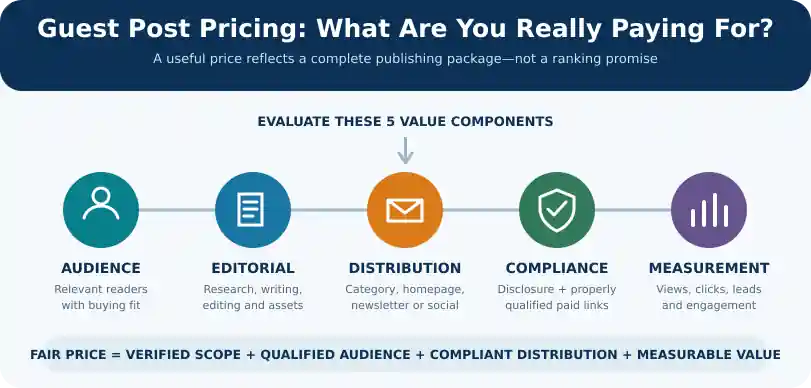
Guest Post Pricing: How to Evaluate Cost and Value in 2026
Practical guest posting and SEO guidance from Guestpost Software.

What Is AI-Powered Media Outreach Platform?
Practical guest posting and SEO guidance from Guestpost Software.