
What Is Media Outreach? Everything You Need to Know for 2026

What Is Guest Posting? Everything You Need to Know for 2026
In most of the last ten years, someone has proclaimed the death of guest posting. Google's crackdowns, Google's algorithms and the rise of AI-generated content have all been used as excuses to drop this tactic. Yet, it's 2026 and not only is guest posting very much alive, but it has also become a highly defensible link-building and brand-building strategy for companies that aren't playing games.
There's a reason why. In a world of AI-generated spam creeping into every corner and consumers becoming ever more critical, a byline in a trusted publication is valuable because it is difficult to achieve. Editorial trust is scarce. And links from trusted publishers are more valuable than ever. Companies that saw this coming early are benefiting from organic search and brand awareness.
This guide cuts through the noise. If you're a founder trying to build brand awareness, an SEO manager selling content strategy to your boss, or an agency seeking to build links at scale for your clients, this is the definitive guide to guest posting in 2016: what it is, why it matters, and how to do it right.
DEFINITION
What Is Guest Posting?
Guest posting - or guest blogging, as it is also commonly referred to - is the act of publishing a piece of content on someone else's website. In exchange for a byline, branding, and often one or more links back to the author's website. For organisations, it provides a formal mechanism for building an audience, enhancing domain authority and improving organic search rankings in a way that rests on the creation of editorial content which appears on other, respected platforms.
But it's more complex than that: what guest posting does for a business
Typical explanations of guest posting rest on a simple equation: write an article, get a link. This understates the value of the strategy and overstates the speed at which it will work. In reality, guest posting is at least a three-fold strategy, and to make guest posting work you have to understand all three.
The first level is SEO. When you write an article on a high-authority website and they place an editorially relevant link back to your site, that's a stamp of approval as far as search engines are concerned. Google has always considered backlinks, especially those coming from editorially relevant links from other websites, as a core reading of domain authority. Ahrefs' massive studies of the most effective ranking factors have consistently shown that the number of unique backlinks is the best predictor of organic traffic, by far.
The second level is audience reach. Each of your guest posts puts your content in front of an established audience. A guest post in the right place puts your voice in front of that audience, and not years away from building your own channel. If you do this regularly for several publishers relevant to your audience, this has a snowball effect - your brand gets out there so that potential customers see your name in multiple places before they search for you specifically.
The third level is positioning as an expert. It's an often overlooked but critical level in 2016. With the rise of AI-generated content on the search engine results page, Google's E-E-A-T (Experience, Expertise, Authoritativeness, Trustworthiness) algorithm has become a more visible factor in determining which content gets ranked and which doesn't. Being able to have your name on work published on reputable third-party websites is one of the strongest indicators of expertise that the current algorithm takes into account.
The Six Stages of Guest Posting
The main reason businesses fail with guest posting, and stop doing it, is because they view it as an isolated event. There are six steps to the process and, more often than not, it's a failure to follow them all that leads to failure.
Stage 1 - Site Research
The key to any guest posting campaign is finding target sites. The perfect site is the happy medium between three things: topical fit (site's audience is interested in your business), site authority (Moz's Domain Authority and Ahrefs' Domain Rating are good proxies, and most link builders are looking for sites with DA/DR 40 or higher to pass on link equity), and any sort of traffic (real people, real visitors, not a link farm).
Target site research involves examining their guidelines, reviewing the quality of content they publish, their social media activity and whether they promote author work. It's often less important to work with a DA 60 site that doesn't promote your guest posts, than with a DA 45 site that has a newsletter and active social media presence.
Stage 2 - Pitching
Pitches are the lifeblood of guest blogging. Editors at quality sites receive dozens (if not hundreds) of boilerplate pitches per week. The successful ones have a common format: they show the editor that the writer has read their site, they pitch an angle on a topic, rather than a topic, and explain in one sentence why the angle should be of interest to the editor's audience.
"I'd like to write about SEO for your blog" fails. "A pitch that says "Your readers in the B2B SaaS space are underserved on the topic of programmatic SEO for product-led growth companies - I've run two such campaigns and can share what the data showed" is better. Relevance and specificity are the only two ingredients for a cold pitch.
3 - Guest Post
In writing the post, you have to write for the audience first and your company second. Guest posts that smack of thinly-veiled self-indulgence are either outright rejected or published without the publisher's imprimatur. The most successful guest posts are useful, well-researched articles that just happen to be written by someone with the requisite expertise - expertise that both the author's byline and backlink communicate.
In 2016, "genuinely useful" means something different. AI has made it easier than ever to churn out "thin content". Editors now know the difference between posts that include original research, experience or insight, and posts that regurgitate existing content. If your guest post can be written by any internet user with a Google account, it may not find its way into a publication you'd want to be published in.
4 - Submission and Follow-up
Editors typically take two to eight weeks to publish a post. One polite follow up after two weeks is customary. After that, it gets ugly. An excel file or simple CRM to track your submissions - the name of the site, the date you pitched, the status of the pitch, and the publication window - avoids the chaos that leads to a lack of consistency.
Step 5 - After Publication
The job isn't done when the post publishes. Track the backlink in your backlink monitoring tool of choice, track the referral traffic in Google Analytics 4, and check if the post attracts any further coverage or shares. Successful guest posts can lead to longer-term contributor relationships - much more efficient than finding new publishers to write for.
Guest Posting and Backlinks: Link Quality is Everything
Not all guest post backlinks are created equal, and knowing why can help you build a strategy based on quality, rather than quantity.
There are a number of factors search engines use to judge the quality of a link. The first is relevance - a link from a marketing blog to a marketing software company is more relevant contextually than a link from a finance blog. Authority is the second - a link from a site that's overall authority (estimated by metrics such as Moz's Domain Authority or Ahrefs' Domain Rating) is passed from the linking site. Placement is the third - a link used contextually within the content of an article is viewed more favourably than a link shoehorned into an author's profile with no context.
Moz's experiments with link-building consistently demonstrate that a few quality, relevant links from authoritative publishers are more effective than hundreds of low-quality links from non-relevant or non-authoritative publishers. For business organic search strategies, that means that guest posting to a targeted list of 15-20 relevant, authoritive publishers is much more likely to succeed than a mass guest posting campaign to hundreds of less authoritative sites.
Timing is also a factor. Backlink profiles that grow organically, slowly and steadily - the natural consequence of building a business that consistently produces high-quality external content - are a much more welcome sight to Google's algorithms than profiles that suddenly spiked with tens of links from similar-looking sites. Slow, steady guest blogging is not only best practice in terms of editorial quality; it is also better in terms of algorithmic considerations.
Guest Posting in the Age of AI: 2026 vs 2023
The introduction of mass-market AI writing platforms over the last couple of years triggered an existential crisis for the industry. By 2025, most low-quality guest post pitches sent to publisher inboxes were either generated by AI, or edited versions of that generation. In response, publishers adjusted their guidelines, introduced human review and raised their standards.
This has been, ironically, great news for the companies who invest in expertise-based content. If all your competitors are using AI to churn out code-written copy, what value is there in publishing an article that's founded on actual expertise, insight, or data? Google's Helpful Content system and its ever-evolving quality raters' guidelines specifically favour content that shows expertise - a depth that simply can't be distilled from web content.
In other words, the guest posts that will perform best in 2016 will be those centred upon something that AI cannot provide: your data, your case studies, your insights based on your own experiences as an industry professional. AI can help with research, creating outlines and proofreading, but the meat of the guest post that gets published on a high-quality publisher needs to be sourced from a human expert.
For corporate marketers, who use guest blogging as part of their content strategy, this is a blessing. The bar for quality has been raised, meaning the companies meeting that bar are less likely to be competing for attention in their publishers' contributor lineups, and for attention in search rankings.
Identifying Appropriate Publishers: A Process
Finding the right publishers is a search and research activity that benefits from a methodical approach. There are a couple that work across sectors.
The competitor backlink method is based on the backlinks of your top organic competitors as measured with a tool such as Ahrefs or Moz. Editorial backlinks to your competitors are, by extension, relevant to your niche and willing to accept third-party content. You can use Domain Authority to further prioritise the list and check the sites' contributor guidelines to ensure that you're not wasting time.
The topical search method is a Google search. "Write For Us" plus niche terms list sites looking for contributors. You can narrow down the list by location, industry or audience. When you add filters to your search, excluding forums, directories, and clearly spurious websites, you have a manageable list in less than an hour.
The relationship approach, more time-intensive but more effective, is to develop rapport with the editors and guest bloggers in your space. By participating in published conversations, and offering expertise in places where editors are active, you build a rapport that helps warm up those cold pitches. Relationship-based guest posting campaigns generate better results, better links and better opportunities over time than cold pitches.
Guest Posting Mistakes
What separates guest posting campaigns that deliver positive results from those that are a waste of time is typically a list of common mistakes.
The first is a numbers over quality emphasis. There's little point pitching to 20 substandard sites when 5 great sites will do, and the time savings are considerable. It's hard to say whether the link equity you get from ten links on DA 20 sites is worth the equity you get from two links on DA 70 sites in the same industry.
Failing to target your audience is the next most common mistake. A link built through guest posting on a site where the audience is not interested in your service or product generates no referrals, no brand awareness and even the link value that passes through the link is weakened by the irrelevance. You can't guest post without relevance, because relevance is the entire point of guest posting.
Guest posting that is written for search engines rather than humans is unreadable and unread. The sites worth writing for have gained subscribers by being published with integrity. Guest posts that obviously written to include an excessive number of keywords and phrases, or which cannot be read without straining to find the keywords, announce that the author is not writing for the reader.
Finally, guest posting as a one-off rather than a sustained effort reduces its compounding benefits. Companies that get the greatest benefit from guest blogging use it as a disciplined practice at a set time - not a one-off approach used to launch a new product or service.
Frequently Asked Questions
What is the difference between guest posting and guest blogging?
They are synonyms. Guest posting used to specifically describe guest contributions in the form of blog articles, whereas guest blogging refers to the activity of guest posting on blogs. However, both refer to the act of writing articles for other websites in return for a credit and usually a link.
Is guest posting still good for SEO in 2026?
Yes, if done right. Editorially positioned and contextually relevant links are still one of the most important organic ranking factors. Google has always spoken of quality guest posts, and clearly separated those from link schemes - it continues to reward the former and penalise the latter.
How many backlinks should be in a guest post?
Editorial guidelines typically allow one to two backlinks in the body of a guest post and one backlink in the author bio. The quality and relevance of links is more important than quantity. One contextual link to a relevant, helpful resource on your website will be more valuable to your readers and more likely to be accepted by the site's editor than several non-editorial links to product pages.
Where can I guest post?
The best three ways are: using tools such as Ahrefs to analyse the backlink profile of your competitors to find sites that have accepted guest posts in your industry; performing Google searches for "write for us" plus your industry keywords; and reaching out to editors or contributors via industry communities, before writing for them. Technology such as GuestPost Software also collates verified guest post opportunities across 50,000+ sites, saving time on the research process.
How long should guest posts be?
While publisher requirements differ, the average length of guest posts accepted by high authority publishers is around 1,200 to 2,500 words. Content quality is more important than length - a well-researched 1,500-word post with expert insights will trump a flabby 3,000-word post with generic content.
Can I write guest posts with AI help?
AI can help with research, outlines and revisions, but guest posts entirely written with AI are increasingly detected and dismissed by reputable publishers. More to the point, the human perspective and expertise that makes a guest post valuable to readers is exactly what AI tools don't have. By 2026, human and machine editors alike value human expertise signals; AI-written content will not rank well if it doesn't have these signals, even if it is otherwise grammatically correct.
When do guest posts work?
Link equity from backlinks begins to influence rankings in four to twelve weeks following publication of the post, depending on the crawl rate and authority of the publishing domains. Audience and brand impact - such as direct referral traffic or newsletter subscriptions, brand name searches, etc - can be tracked almost immediately. The cumulative advantages of a longer term guest posting strategy become apparent after six to 12 months of guest posting.
What's the difference between guest posting and paid links?
Yes, and this has legal and search engine implications. A guest post is published because it is considered editorially relevant; the backlink is an editorially chosen link. A paid link placement is a fee paid to a site for a link that Google's guidelines require to be marked as nofollow or sponsored. Un-disclosed paid links are prohibited by Google's link scheme guidelines and risk penalty. Reputable guest posting programs create editorial links - not paid links dressed up as editorials.
The Bottom Line
Guest blogging has defied all the naysayers for the very simple reason that it is based on a principle that will never go out of fashion: quality publishers endorsing quality authors adds value for readers, for search engines and for companies whose expertise is endorsed. The bar for doing guest posting right has been raised. In 2016, the strategy is even more closely tied to specificity, credibility and quality.
If a business is prepared to pay for that quality - to pitch those publishers, to pitch those angles, to write that content - then guest blogging is still one of the most valuable things a business can do in an organic growth strategy. The cheats largely no longer work. The basics still work better than ever.
References
Ahrefs. (2024). What are Backlinks and Why Do They Matter for SEO? ahrefs.com/seo/glossary/backlinks
Ahrefs. (2024). The Beginner's Guide to Link Building. ahrefs.com/seo/link-building
Moz. (2024). What is Domain Authority? moz.com/learn/seo/domain-authority
Moz. (2024). Beginners Guide to Link Building. moz.com/beginners-guide-to-link-building
Google Search Central (2024). Link Scheme Policy. developers.google.com/search/docs/essentials/spam-policies#link-spam
Google Search Central (2024). Creating helpful, reliable, people-first content. developers.google.com/search/docs/fundamentals/creating-helpful-content
GuestPost Software. (2026). Guest Post Marketplace - 50,000+ Verified publisher sites. guestpostsoftware.com
Ready to place content on verified websites?
Browse verified editorial opportunities →Transparent publisher metrics and pricing on guestpostsoftware.com.
Share
About the author
Guestpost Software Editorial Team
Editorial and SEO insights from the Guestpost Software team—guest posting strategy, publisher relationships, and measurable content outcomes.
About Guestpost Software · Our editorial process · Help Center
Related posts
Continue reading

Benefits of Guest Posting in 2026–2027: What Still Works, What Does Not, and How to Measure Real Value
Practical guest posting and SEO guidance from Guestpost Software.
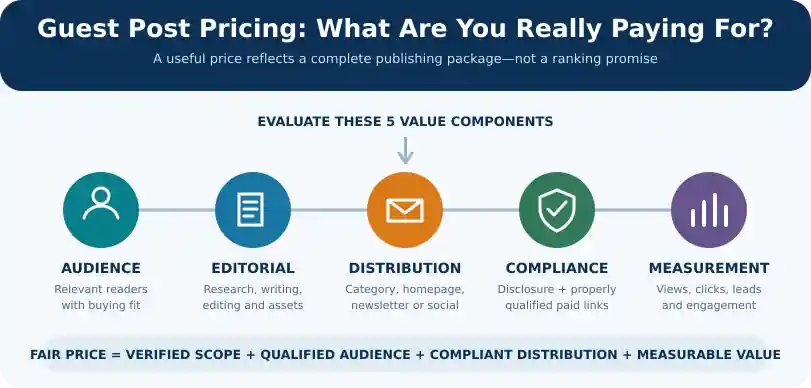
Guest Post Pricing: How to Evaluate Cost and Value in 2026
Practical guest posting and SEO guidance from Guestpost Software.

What Is AI-Powered Media Outreach Platform?
Practical guest posting and SEO guidance from Guestpost Software.
Media Outreaches: How much should you pay in the USA?
Practical guest posting and SEO guidance from Guestpost Software.

Media Outreach Platform and Media Outreach Agency
Practical guest posting and SEO guidance from Guestpost Software.

Best Media Outreach Platforms in the USA (2026)
Practical guest posting and SEO guidance from Guestpost Software.