
Media Outreach ROI: The Cost vs Traffic vs Rankings
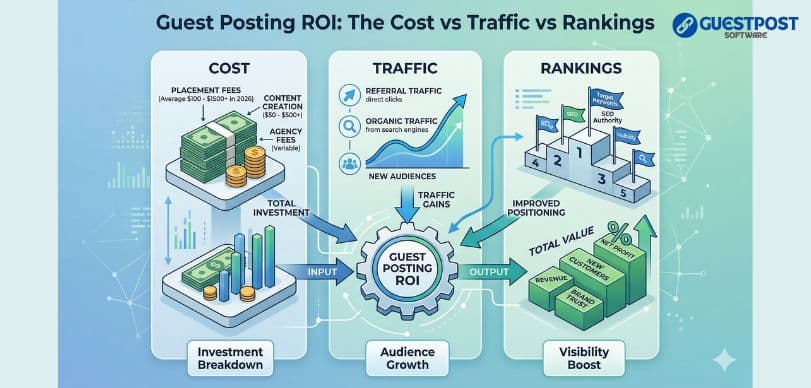
Media Outreach ROI: The Cost vs Traffic vs Rankings The Ultimate Guide to ROI of Media Outreach in 2026. Introduction: Is Media Outreach Actually Worth it 2026? The phrase Media Outreach is likely to have been repeated a million times: it is one of the most effective methods of creating backlinks and developing authori…
Media Outreach ROI: The Cost vs Traffic vs Rankings
The Ultimate Guide to ROI of Media Outreach in 2026.
Introduction: Is Media Outreach Actually Worth it 2026?
The phrase Media Outreach is likely to have been repeated a million times: it is one of the most effective methods of creating backlinks and developing authority as well as a natural influx of traffic. This is the question that most marketers are putting under their breaths-
The fact is that many businesses invest thousands of dollars in the campaign of Media Outreach and do not have a clear method of measuring the return. They get a trickle of back links, perhaps an increment in traffic, but they are unable to draw the line to actual revenue results. That's a problem.
It is a guide, who might want a straight and honest explanation of the Media Outreach ROI How much it will cost in 2026, what you will be able to gain in agreement, and how to compute whether your link building ROI will be always worth the money.
By the end of your reading, you would know precisely what your Media Outreach are doing to your business and whether you should spend more, less or smarter.
What Is Media Outreach ROI and Why is it Important?
Defining Media Outreach ROI
The Media Outreach ROI is merely a value you will receive in the amount of what you give to be published at other websites. However, in comparison to a paid advertisement where you can easily tell the number of clicks that you have purchased with a specific dollar, Media Outreach ROI is multifaceted. It involves:
Host- site referral traffic to yours.
Better ranking of search engines using high-authority backlinks.
Exposure and audience development of the brand.
Domain Rating (DR) or Domain Authority (DA) increases.
Future income of leads or conversion done through organic growth.
The vast majority of the SEOs when discussing ROI of link building are in fact posing the question: does this backlink shift the needle on my rankings to the extent that it warrants the expenditure on obtaining it?
The reason why Media Outreach has become the de facto of link building.
The algorithm that Google uses has never underestimated the links as a vote of confidence. An outbound link to a reputable, niche-specific site informs the Google of the fact that your content should be ranked. Media Outreach is the best way to have editorial control, i.e. you compose the content, you select the anchor text, and you establish your relationship with the real publisher instead of paying to be listed in a directory.
Based on the statistics of the Ahrefs and SEMrush studies that are to be published at the beginning of 2026, pages which have strong backlinks portfolios of authoritative domains are ranked much higher on average compared to pages in which on-page SEO is the sole principle used. The only area that has continued to provide this is in Media Outreach which is also a white-hat technique.
The Future of Media Outreach Costs in 2026: What You Are Paying.
We shall get right down to the figures. The cost of Media Outreach has been materially affected during the last two years since the demand has grown and quality publishers have become more discriminating.
Dismantling the Cost Elements.
The Media Outreach services that you pay are usually a mix of the following:
Writing content: $50-300 on the basis of the length and experience.
Outreach and placement fee: $80 -600 and above based on authority of the sites.
Commission to the agency management: 20-40 percent of the placement cost.
Internal time expenses: most people do not consider time costs when it comes to outreach, yet 5 to 15 hours per placement can be incurred.
The hidden cost of time is one of the factors that many businesses do not put into consideration. Assuming that your in-house marketer works 10 hours monthly on outreach, and makes 50/hours, then that would be a 500 labour cost - prior to a single post being published.
Is Self-employment cheaper than agency?
This is solely dependent upon your size and your skill. Self-service Media Outreach can be as cheap as $100 -200 per link (content and small placement fee) in case you do your outreach. Yet, it takes good relationship managerial skills and hard work. Agencies normally provide faster links with a high premium attached to the convenience. The hybrid strategy, which is in-house strategy with agency-selective use, is usually the most effective in terms of ROI in link building among most developing businesses.
Actual Media Outreach ROI Cases: What the Figures Are Like.
It is time to leave the theory and consider the real-life examples that can demonstrate how the ROI of Media Outreach works under various types of businesses.
Example 1: SaaS Company developing Domain Authority.
One of the mid-sized SaaS firms that provided services to HR departments spent 4,000 on a monthly basis on Media Outreach - 8-10 posts monthly on DR 50-65 websites. Over 6 months:
Total investment: $24,000
Backlinks obtained: 52 (a combination of DR 5070 domains)
Growth in organic traffic: +38% in the course of time.
Projected growth in organic revenue: on average, 11200/month in month 6.
Break- even point: Month 8 after campaign commencement.
Although the business did not get immediate returns, their Media Outreach campaign made them self-sustaining within the first 10 months, as the gains on rankings generated a compound traffic, which kept increasing without further investment in the links.
Example 2: Where the e-commerce store targets niche keywords.
A small e-commerce shop that specializes in selling specialty outdoor gear was the one that carried out a focused push in terms of a Media Outreach that was directed to 5 core product keywords. They paid 1800 USD in 6 Media Outreach in 3 months on outdoor blogs that were relevant to the niche (DR 4055):
Referral traffic in the posts: approximately 320 sessions.
Referral conversion rate: 2.1 (warm referral traffic average in the industry)
Referral traffic: 900 -1000.
Ranking gains Organic: 3 out of 5 target keywords shifted on page 1 after 5 months of time.
Projected increase of the monthly organic revenues at month 6: $2,100.
In the case of this business the direct referral revenue was not worth paying that much. However, the improvements in ranking -and the stable organic revenues that were opened by them- made the ROI of the Media Outreach very positive in the 6-month perspective.
Example 3: Local Service Business (Law Firm)
One of the competitive metro areas in which a personal injury law firm was incurring a cost of $3,500/month with a legal-niche Media Outreach agency. Over 4 months:
There are 12 placements on law news and bar association-family sites (DR 5575).
Target query personal injury attorney [city] has been relocated in the position 14 to position 4.
The organic leads grew to 31/month as compared to 8/month.
Average case value: $12,000
Even an increment of 1 case every month = 343 percent ROI of monthly investment.
Calculating Your own ROI in Media Outreach.
The most effective method of cutting through the noise is to develop a basic ROI model that is business specific. The following are some of the steps to follow:
Step 1: Determine Your Feminist Baseline Metrics.
Record your present condition before you initiate any kind of Media Outreach campaign:
Google Search Consol monthly organic traffic.
Mean rate of conversion of organic traffic.
The average revenue per conversion.
Ranking of key words of your target terms.
Step 2: Realistic Outcomes of the Project.
Depending upon the authority of your domain as present and the competitiveness of your target keywords, establish the conservative, moderate, and optimistic traffic. The presence of DR 35 site with moderately competitive keywords will be able to achieve a 15-30 percent organic increase in traffic within 6 months of regular Media Outreach.
Step 3: Calculate ROI Formula.
🧮 Find your ROI Formula of Media Outreach
ROI (%) = [(Revenue Gained from Organic Lift − Total Campaign Cost) ÷ Total Campaign Cost] × 100Example: ($9,000 revenue gained − $6,000 campaign cost) ÷ $6,000 × 100 = 50% ROI
Step 4: Monitor and Change on a monthly basis.
Good tracking gives you a good ROI calculation. Install monthly check ins to review:
The target terms change their positions in the keyword list.
Royalty rate in organic traffic.
The traffic referred to certain Media Outreach.
Domain Rating (DR) or Domain Authority (DA) progression.
How to avoid What Kills Media Outreach ROI.
Even a Media Outreach campaign that has been well-invested in will not give a significant ROI. The following are the most frequent errors and ways of avoiding them:
The first one is attacking sites that have inflated metrics.
Others attribute the exaggeration of the DR scores by sellers to the use of the private blog networks or link exchanges. It is also necessary to check the traffic of a site on your own (with Ahrefs, SEMrush, or SimilarWeb) before investing. The DR 60 and 200 monthly visitors site is a warning sign - and will not provide any substantial referral traffic or ranking power.
2. Ignoring Niche Relevance
The link of a general lifestyle blog with high DR will not do much good to a B2B cybersecurity company as a mid-DR security industry magazine would. Relevancy is a very important indicator that Google employs to determine a good link profile. Focus more on topical congruence as opposed to raw domain authority scores.
3. Creating Impossibly Short-term Goals.
The ROI of the Media Outreach is hardly instant. Companies that stop campaigns in 60 days on grounds that they were not getting results normally give up just before the compound effects would have taken effect. Agree to a period of 4-6 months, prior to performance appraisal.
4. inconsistent Strategy of Anchor Text.
Excessive use of exact-match anchors is an indicator of the wrongness of the Google algorithms. Healthy link profile consists of a combination of branded anchors and partial-match anchors as well as phrases that sound natural. Too optimized anchor text will lead to manual penalties that will destroy your ROI overnight.
5. Neglecting Content Quality
The article containing 500 words and barely satisfying the audience of the host site will not attract a lot of link equity, and will not help to attract referral traffic, as well. Quality publishers are looking forward to 1,000 -1,800 word well-researched articles in 2026. Better placements, relations with the editor, and high referral conversion rates are compensated by investing in really helpful content.
The future of Media Outreach ROI in 2026.
The difference between high-performing teams and the rest is that in the former, they extract as much value as possible out of each dollar spent on posting a guest.
Targeted, High-Traffic, Niche-Relevant Sites.
Not only to purchase links, but to purchase audiences. Places of high and active readership are good to get good referral traffic that is convertible. A target list is to be built based on domain authority and the amount of traffic each month.
Reuse and Re-Brand Every Media Outreach.
Any Media Outreach should not be only promoted through publication. You can share it in your social media, you can also include it in your email newsletter, and you can also mention it in your own blog content. This will inform the search engines that the content that is being linked is alive and appreciated - increasing the effective authority of the link.
It is not about creating links but building relationships.
The most successful link builders are the ones that consider the editors as long-term relationships and not one-time business. A good association with a DR 70 publisher would be worth a dozen one and done DR 50 placements. Frequent contributors are usually placed on prime slots, treated better by the editors, and expedited in their turnaround time. All these will add to your ROI in terms of link building in the long run.
Track Full-Funnel Attribution
UTM parameters should be used on all links of the Media Outreach so that you can not only measure the number of sessions, but also conversions and revenue that the particular source of referral generates in Google Analytics 4. This provides you with real dollar-in, dollar-out information and not the metrics of vanity.
Summary: Is Media Outreach ROI Worth It in 26?
The point is, though, that in 2026, Media Outreach is one of the most ROI-efficient link building strategies that can be used in case it is implemented strategically. Purchasing inexpensive and irrelevant links will not be able to push the needle. The dedication to good placements on high authority, niche-specific websites, the ability to design genuinely useful materials, and adequate performance metrics and measures will.
A good Media Outreach campaign is between 1, 500 and 8,000 and above per month depending on the size and quality. The returns - when well followed - will keep giving 2x-10x ROI in a 6-12 months period, with compounding benefits that will last long after the campaign period.
Provided that you are serious about organic development and creating a sustainable SEO power, Media Outreach should take center stage in your link building plan. It does not matter whether it works or not, it only matters whether you are in a position to measure it right and allow it sufficient time to deliver.
Ready to place content on verified websites?
Browse verified editorial opportunities →Transparent publisher metrics and pricing on guestpostsoftware.com.
Share
About the author
Guestpost Software Editorial Team
Editorial and SEO insights from the Guestpost Software team—guest posting strategy, publisher relationships, and measurable content outcomes.
About Guestpost Software · Our editorial process · Help Center
Related posts
Continue reading

Benefits of Guest Posting in 2026–2027: What Still Works, What Does Not, and How to Measure Real Value
Practical guest posting and SEO guidance from Guestpost Software.
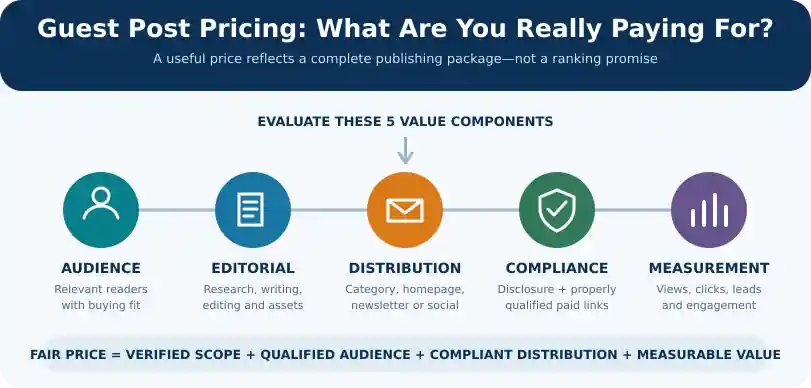
Guest Post Pricing: How to Evaluate Cost and Value in 2026
Practical guest posting and SEO guidance from Guestpost Software.

What Is AI-Powered Media Outreach Platform?
Practical guest posting and SEO guidance from Guestpost Software.
Media Outreaches: How much should you pay in the USA?
Practical guest posting and SEO guidance from Guestpost Software.
Media Outreach Platform and Media Outreach Agency
Practical guest posting and SEO guidance from Guestpost Software.

Best Media Outreach Platforms in the USA (2026)
Practical guest posting and SEO guidance from Guestpost Software.