
Media Outreach Without Agencies: See Through Market Model
Purchase Guest Posts Without Agencies: See Through Market Model The ultimate guide to buying quality guest posts straight and knowing how to price a guest post and create potent links without the need of any middlemen. Introduction: The issue with The Conventional Guest Posting Purchasing You are well aware of how anno…
Purchase Guest Posts Without Agencies: See Through Market Model
The ultimate guide to buying quality guest posts straight and knowing how to price a guest post and create potent links without the need of any middlemen.
Introduction: The issue with The Conventional Guest Posting Purchasing
You are well aware of how annoying it is to attempt to purchase guest posts to your site. You place a call to an agency and wait several days before a reply, receive an offer which appears to come out of the thin air, and then waste several weeks going back and forth on the quality of the site, its relevancy to your niche and how many weeks it will take. The process has taken longer to manage you than to grow your site when the post is published.
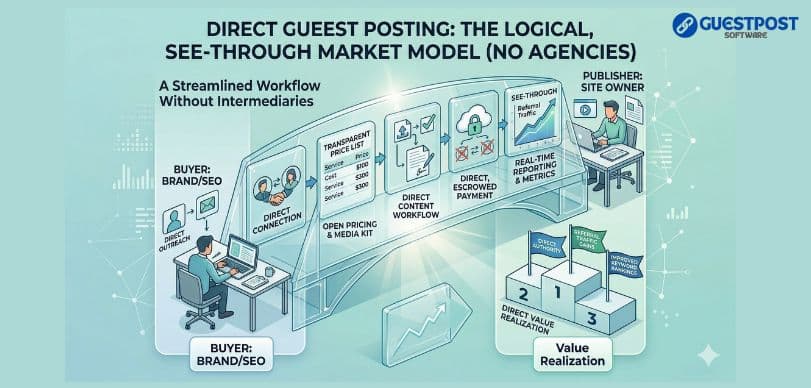
This is not necessarily how it has to be in the world of guest posting. Increasingly webmasters, search engine optimizers and online marketers are abandoning the agency system and moving to an open marketplace where prices are transparent, publishers are on lease, and you remain in direct control of the entire process.
This tutorial will show you the way to purchase guest posts. You will know what to check in a market place, how the prices of guest posts are set, how the backlinks you get when getting good placements help on the rankings and how to avoid the pitfalls which cost you money without a difference.
What is the Real Meaning of Buying Guest Posts?
Guest post is an article posted on the web of another individual and this article has a reference to your site. Purchasing guest posts is actually just spending money to have that content placed on a third party site, as well as a backlink that informs the search engines like Google that the site is reputable.
This is a hybrid approach of SEO and content marketing. It is a legitimate source of topical authority, referral traffic, and an overall improvement in the ranking of your domain by the search engines, when it is done correctly. Spamming of bad sites or use of irrelevant content will actually damage your rankings.
Guest Posts vs. Paid Links: The Difference between the two
One should understand the distinction between purchasing a link or a guest post. An actual guest post contains original useful content that actually suits the voice and the audience of the host site. The content partnership will also result in the backlink, and not merely a link that was inserted on an existing page.
Having a transparent marketplace, you are able to know what exactly you are paying before you part with a single dollar. It encompasses the domain authority of the site, traffic estimation, niche category as well as editorial guidelines.
Why Open Marketplaces are better than the Traditional Agencies
The conventional guest post agency model is effective in situations where the information imbalance exists. Agencies are aware of the sites they collaborate with, the charges they imposed on the sites and the margin they put on the price. As a buyer, you are only being shown the final bill. Such ambiguity may result in increased expenses, diminished quality and non-congruent incentives.
A clear market place alters the equation in a number of major ways:
Transparent pricing: You can view the price of every placement immediately, and no flat rates or unpleasant surprises.
Publisher statistics on display: Domain Authority (DA), Domain Rating (DR), organic traffic, and spam scores are displayed freely allowing you to compare sites such as products.
Direct communication: There are numerous options where you can directly communicate with publishers, make sure the editorial fit is right and negotiate directly with them without using an agency.
Standardized vetting Reputable marketplaces check all publishers prior to listing them, eliminating private blog networks (PBNs), link farms, and artificial traffic sites.
The outcome is a process that is not as black box as it is more of a confidence shopping process. You select the locations that fit your niche and financial means, make your order, and follow the delivery all on a single dashboard.
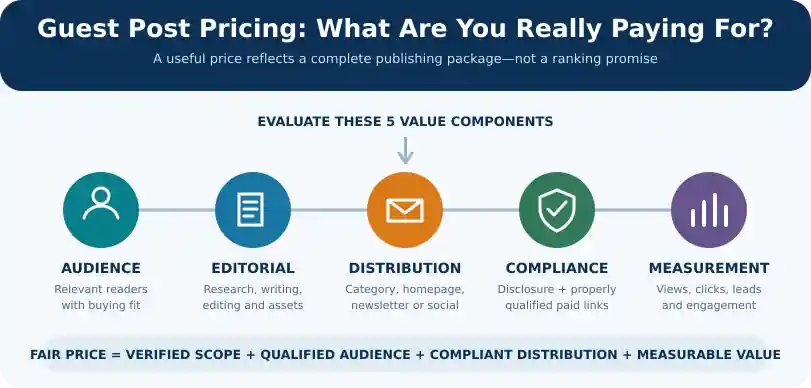
How to know Guest Post Pricing: What You Are Really Buying
The price of guest post differs tremendously, with the cheapest ones being in the range of 30 and the most expensive ones being in the range of several thousand and over when it comes to placing on high authority websites with high organic traffic. The first step to spending your budget wisely is to understand the reason behind the differences in prices.
Can Guest Post Pricing Find a Happy Mediocrity?
In most cases where the website is small to medium sized and the target market is competitive, yet not hyper competitive, then the range of between $80 and $250 is likely to give the best pay-off. The sites in this category are usually in the 30 to 50 range in terms of DA, the back links are in the thousands, and the editorial quality is such that the links appear natural and worth having to the search engines.
The Real way Quality Backlinks Shift Your Rankings
The main fact, which should be at the center of every guest post campaign, is that backlinks are one of the most significant ranking factors in Google. Not all back links are created equal. The links that do transfer your rankings are those that have certain unique features which make them not as similar to the low-value placements.
The value of a Backlink
The following characteristics are likely to be common with high-quality backlinks of the guest posts:
Topical relevance: An interconnection of a site within your industry means so much more than an interconnection with a niche site. The algorithms of Google are advanced to the extent that they will analyze the contextual sense of a link.
Editorial placement: The links that are embedded in the natural flow of well written content are not seen as the same as the ones that are crowded in the footers, in the sidebars, or author bio.
Association of domain authority: Backlink of high authority domain has more link equity (ranking power) that may be transferred between a site and another.
Traffic lights: Traffic links that are received on pages, which are actually being visited by real people are regarded as more credible compared to those links that are inactive or never visited.
By purchasing guest posts using an open market, you are able to make narrow selections of sites that fit these requirements in particular - as opposed to an agency making blanket promises of high quality placements.
The Guide to Evaluating a Guest Post Marketplace Before Purchase
All platforms that provide the services of a so-called transparent guest post marketplace do not always fulfill this promise. This is a working checklist that you can use before investing on any platform.
Publisher Vetting Standards
A good market will be honest regarding the screening of publishers. Find sites that will have an editorial review of all their sites, organic traffic (confirmed using third-party software such as Ahrefs or SEMrush), no spammy outbound links and no evidence of private blog networks.
Metrics Transparency
All the listings must display, at least: Domain Authority or Domain Rating, estimated monthly organic traffic, spam score, niche category, and turnaround time. When one of the platforms conceals this information or causes you to seek it out individually, it is a red flag.
Refund and Revision Policies
What is to become of you in case what is published fails to comply with your brief, or the metrics of the site dropped sharply since the listing? The marketplace will be credible with a transparent policy on revision and refunding. Generalized language such as satisfaction guaranteed, but there is no detail provided should raise a red flag.
Seller Reviews and Ratings
The responsibility is generated by user-made reviews and ratings of the individual publishers. When you are in a position to tell that 40 other buyers have already used a certain site and gave detailed feedback, you are getting social proof that a sales page is not capable of giving.
A Stepwise Guide to Efficiently purchase Guest Posts
Whether you are running your first link building campaign or scaling an established strategy, following a structured process ensures you get consistent results from every dollar you spend.
It is crucial to define your goals. Is this the development of topical authority, the growth of a particular landing page, or the diversification of your backlink profile? It is the objective of the goal that will make you target a particular site and at what price point.
Establish an acceptable budget. In the majority of cases, when the initial campaign is in the early stages, 5 to 10 placements at the start of the month in the $80 to $200 area allows you to have sufficient data to gauge the impact before scaling.
Search based on niche and metrics. Filter through the filters of the marketplace to identify sites within your industry that have a DA/DR of more than 30, a monthly traffic of more than 1,000 visitors, and a spam score of less than 5%.
Browse the site using your fingers. Do not stick to automated metrics only. Go to the site, read some of the latest articles, see where the links are put in already existing guest posts, and evaluate whether the audience is similar to yours.
Write or brief outstanding information. The article that you are going to place your backlink in must be truly valuable, and it cannot be a 400-word article full of keywords. Strive to have 800-1200 words of real and informative content that can benefit the readers of the host site.
Track your links. After the post has been published, a backlink monitoring tool should be used to ensure the link is Editorial, indexed and links to the appropriate destination page.
Ranking measures of change over time. The consequences of the backlinks are usually 4-12 weeks before SEO can be reflected in search rankings. Monitor your target keywords on a monthly basis and compare the developments with your link building efforts.
Red Flags to watch out for Buying Guest Posts
There are also bad players in the market of guest posting unfortunately. Being aware of what to shun will save your realm the fines and time wastage.
Sites that have overstated DA and have no actual traffic: There are publishers who crank the metrics. The DA/DR should always be compared to real organic traffic by using the services of such tools as Ahrefs, Moz, or SEMrush.
Too many outbound links per page: when all the articles in the site contain 810 obvious sponsored links, Google will at one time or another discard those back links -and possibly even penalize the domain.
Anonymous content mills No author identity or editorial voice Anonymous content mills having no real bylines or editorial voice are typically link farms in disguise as blogs.
Any niche, any subject publishers: There is a focus of real editorial sites. Any sort of site that posts the same in the week about health, finance, travel, and pet care is, by all means, a PBN.
Marketplaces which do not provide vetting information: In case a marketplace cannot say how it vets its publishers, it probably does not.
Ready to place content on verified websites?
Browse verified editorial opportunities →Transparent publisher metrics and pricing on guestpostsoftware.com.
Share
About the author
Guestpost Software Editorial Team
Editorial and SEO insights from the Guestpost Software team—guest posting strategy, publisher relationships, and measurable content outcomes.
About Guestpost Software · Our editorial process · Help Center
Related posts
Continue reading

Benefits of Guest Posting in 2026–2027: What Still Works, What Does Not, and How to Measure Real Value
Practical guest posting and SEO guidance from Guestpost Software.
Guest Post Pricing: How to Evaluate Cost and Value in 2026
Practical guest posting and SEO guidance from Guestpost Software.

What Is AI-Powered Media Outreach Platform?
Practical guest posting and SEO guidance from Guestpost Software.
Media Outreaches: How much should you pay in the USA?
Practical guest posting and SEO guidance from Guestpost Software.

Media Outreach Platform and Media Outreach Agency
Practical guest posting and SEO guidance from Guestpost Software.

Best Media Outreach Platforms in the USA (2026)
Practical guest posting and SEO guidance from Guestpost Software.