
Guest Post Pricing: How to Evaluate Cost and Value in 2026
How to Evaluate Guest Post Pricing Guest post pricing is difficult to compare because two publishers can use the same label for very different offers. One fee may cover editorial review, professional writing, newsletter distribution and a permanent author page. Another may buy little more than an unreviewed article and…
How to Evaluate Guest Post Pricing
Guest post pricing is difficult to compare because two publishers can use the same label for very different offers. One fee may cover editorial review, professional writing, newsletter distribution and a permanent author page. Another may buy little more than an unreviewed article and a commercial link on a site with no relevant audience.
The quoted amount therefore tells you almost nothing by itself. A sound evaluation asks what the publisher is selling, whether the audience is useful, which costs sit outside the quote and whether the arrangement follows search and advertising rules. The goal is not to find the cheapest placement. It is to avoid paying for activity that has no credible route to audience, reputation or measurable business value.
Establish What the Price Actually Covers
Begin by separating the placement fee from the total cost of the contribution. Ask the publisher or intermediary for an itemised scope before comparing offers.
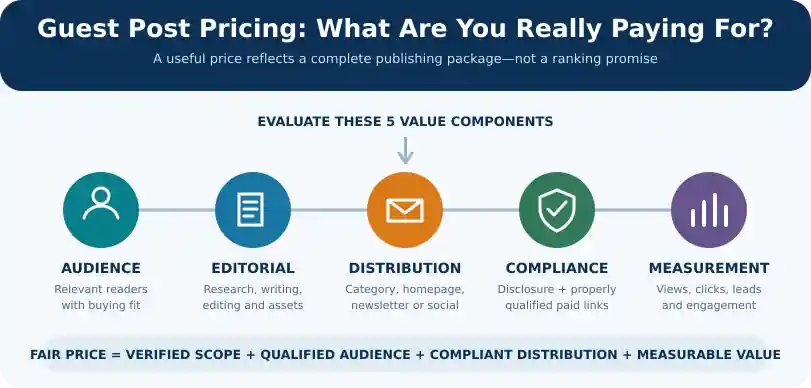
The quote may include:
Topic development and editorial consultation
Research, writing or substantive editing
Images, charts or other production work
Publication in a relevant editorial category
An author biography or contributor page
Newsletter, homepage or social distribution
Reporting on views, clicks or engagement
A defined period during which the article will remain available
Anything excluded still has a cost. Add internal research time, writing, design, outreach, revisions, legal review, project management and post-publication monitoring. Semrush describes guest posting as a process that includes finding relevant sites, pitching editors and producing work that meets the publication's standards.[1] A low placement fee can become expensive if your team must perform every other task.
Clarify the currency, applicable taxes, payment schedule and refund conditions as well. A price is not comparable when one publisher quotes a complete sponsored-content package and another quotes publication only.
Do Not Price a Followed Link as the Product
The most important distinction is between legitimate sponsored publishing and payment designed to influence search rankings.
Google defines link spam as creating links primarily to manipulate rankings. Its examples include paying for posts that contain ranking-credit links and using optimised anchor text in paid guest articles. Google separately instructs publishers to mark advertising or paid-placement links with rel="sponsored"; rel="nofollow" remains acceptable, although sponsored is preferred.
Reject an offer when the seller's main promise is a permanent followed link, exact-match anchor text or guaranteed “link juice.” A higher domain metric does not make that transaction safer. The seller is charging for an outcome that depends on avoiding proper link qualification.
A compliant paid placement can still have value. You may be buying access to a specialised readership, editorial production, brand visibility or referral traffic. Evaluate those benefits without assuming that the link will pass ranking credit. If the economics only work when the paid link improves rankings, the business case is too fragile.
Ahrefs' 2024 discussion of sponsored content cites an older outreach sample in which paid guest posts averaged $77.80.[4] That figure is useful mainly as a warning about benchmarks: the sample covered selected sites with “write for us” pages, did not represent every industry or publication, and included fees volunteered during outreach. It is not a current universal rate or evidence that a similarly priced offer is worthwhile.
Evaluate the Publication Before Comparing Fees
A cheap placement on the wrong site is not a bargain. Before discussing price, confirm that the publication has a real editorial purpose and an audience connected to your subject.
Read several recent articles from different authors. Check whether the site covers your topic consistently, uses credible sources, identifies contributors and edits commercial claims. Inspect its strongest pages and estimated traffic trends rather than relying on a single authority score. Third-party traffic and authority figures are estimates; use them to raise questions, not to make the decision.
Outbound links are especially revealing. A publication that regularly inserts unrelated commercial anchors, publishes many sponsored articles each day or moves between incompatible niches may be operating as link inventory. Immediate acceptance without seeing a topic or draft is another strong rejection signal.
A smaller specialist publication can justify a higher fee than a general site with more estimated traffic. For example, a compliance software company may receive more useful exposure from a modest risk-management journal read by compliance officers than from a broad business blog. The relevant comparison is the cost of reaching qualified readers, not the cost per unit of domain authority.
Check how readers reach contributor articles. Are posts linked from normal category pages? Does the publisher include them in newsletters? Do recent sponsored articles remain accessible and indexed? Is performance reporting based on first-party analytics or an unexplained estimate? These details determine whether the offer includes distribution or merely hosting.
Calculate Total Cost and Plausible Value
Build a simple cost model for each opportunity:
Total cost = placement fee + content production + outreach and management + compliance review + monitoring.
Then identify outcomes that can be measured without making ranking assumptions. These may include referral visits, qualified enquiries, newsletter subscriptions, event registrations, branded searches, useful relationships or invitations to contribute again.
Consider two hypothetical offers.
Offer A costs $150 for publication on a high-metric general blog. Your team supplies the article, receives no editing or promotion, and the seller insists on an exact-match followed link. The low headline price hides production cost and policy risk. Reject it rather than trying to negotiate a cheaper fee.
Offer B costs $700 with an established industry publication. The package includes editorial development, a clearly labelled sponsored article, qualified links, newsletter placement and first-party reporting. The audience matches your buyers. This is not automatically good value, but it can be evaluated as a media and content investment. Estimate the full cost, define a useful audience action and compare it with other ways of reaching the same people.
Do not manufacture a precise return figure when attribution is weak. Record which benefits are measured, estimated or strategic. Brand exposure may matter, but it should not be presented as guaranteed revenue.
Check Disclosure, Rights and Publication Terms
Pricing often changes with usage rights and commercial conditions. Resolve these points before approval:
Will the article be labelled as sponsored, and where will the label appear?
Which links are permitted, and how will paid links be qualified?
Who owns the article and supporting assets?
Can either party reuse, update or remove the content?
Is category, newsletter or homepage distribution guaranteed in writing?
What happens if publication is delayed or rejected?
Will the publisher provide first-party performance data?
Are competing sponsors allowed beside the article?
For material reaching US consumers, Federal Trade Commission guidance says native advertising must not mislead readers about its commercial nature. When disclosure is needed, it should be clear and prominent; the FTC advises placing it where readers will notice it, including near or above an article headline when appropriate.[5] Other jurisdictions may use different rules, so local legal review may be necessary.
A publisher that will not describe its disclosure and link treatment before payment creates avoidable risk. Pause the purchase until the terms are explicit.
Use Three Pricing Decisions: Accept, Renegotiate or Reject
Accept the price when the audience fits, the publication shows editorial control, the full scope is documented, paid links and disclosures are handled properly, and the total cost is reasonable against a defined objective.
Renegotiate when the opportunity is credible but the package is incomplete. You might request newsletter inclusion, clearer reporting, an additional revision round, longer content availability or a lower fee because your team supplies finished copy. Negotiate deliverables, not an unqualified link.
Reject the offer when the value depends on ranking manipulation, the publisher cannot demonstrate a relevant audience, the site functions as a link farm, commercial terms are hidden, or the article can be removed without a reasonable remedy. Some uncertainty is normal; these conditions undermine the product itself.
Keep a short decision record for each purchase. Note the audience, evidence reviewed, full cost, agreed distribution, compliance terms, intended outcome and final decision. After publication, compare expected and actual results. Over time, your own data becomes more useful than a generic guest post price range.
Guest post pricing is fair only in relation to a specific package and objective. Price the work, audience and distribution you can verify. Treat search visibility as uncertain, qualify paid links correctly and walk away when the seller's real product is a ranking promise.
Ready to place content on verified websites?
Browse verified editorial opportunities →Transparent publisher metrics and pricing on guestpostsoftware.com.
Share
About the author
Guestpost Software Editorial Team
Editorial and SEO insights from the Guestpost Software team—guest posting strategy, publisher relationships, and measurable content outcomes.
About Guestpost Software · Our editorial process · Help Center
Related posts
Continue reading

Benefits of Guest Posting in 2026–2027: What Still Works, What Does Not, and How to Measure Real Value
Practical guest posting and SEO guidance from Guestpost Software.

What Is AI-Powered Media Outreach Platform?
Practical guest posting and SEO guidance from Guestpost Software.

Media Outreaches: How much should you pay in the USA?
Practical guest posting and SEO guidance from Guestpost Software.

Media Outreach Platform and Media Outreach Agency
Practical guest posting and SEO guidance from Guestpost Software.

Best Media Outreach Platforms in the USA (2026)
Practical guest posting and SEO guidance from Guestpost Software.
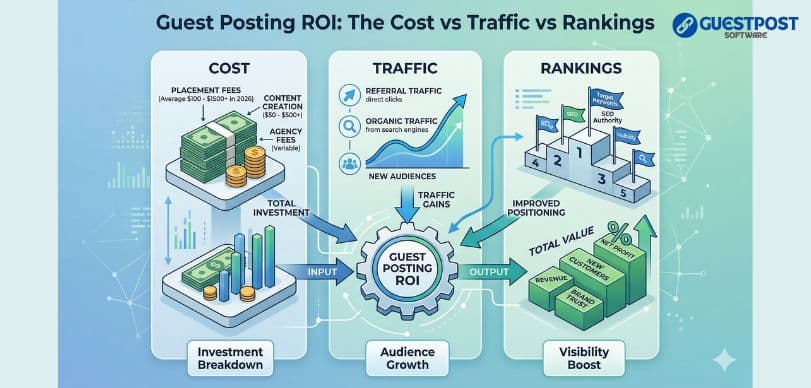
Media Outreach ROI: The Cost vs Traffic vs Rankings
Practical guest posting and SEO guidance from Guestpost Software.