
25 Terms Every Digital Marketer Must Know in 2026 - SEO Vocabulary
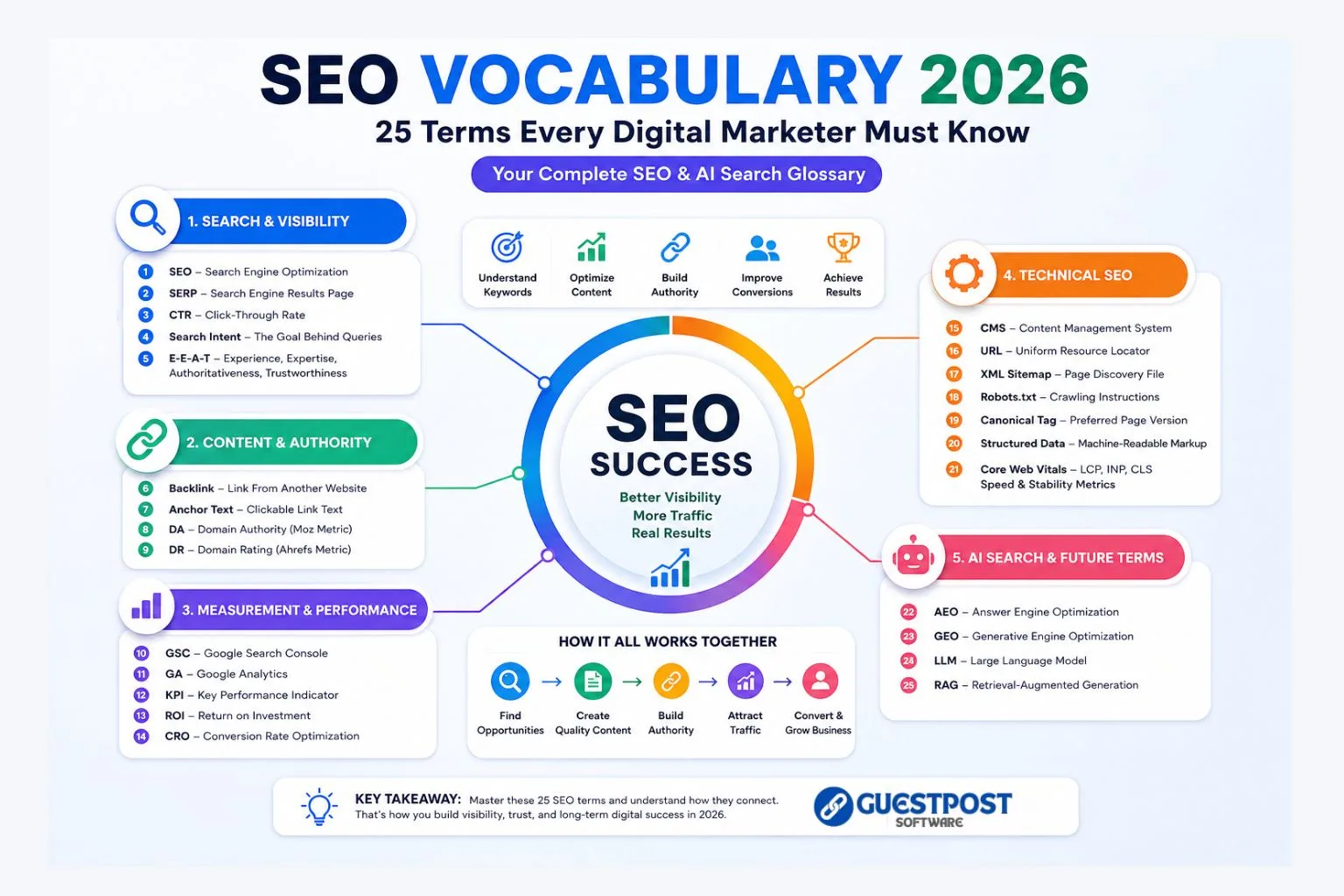
SEO can sometimes feel like learning another language. A single strategy call might move from SEO to SERP, CTR, E-E-A-T, CRO, AEO, GEO, LLM and RAG without anyone pausing to explain what changed. In 2026, that vocabulary has expanded further because traditional search, AI-powered search, content marketing and analytics…
SEO can sometimes feel like learning another language. A single strategy call might move from SEO to SERP, CTR, E-E-A-T, CRO, AEO, GEO, LLM and RAG without anyone pausing to explain what changed. In 2026, that vocabulary has expanded further because traditional search, AI-powered search, content marketing and analytics increasingly overlap in daily marketing work. A term coined for classic Google results now gets applied to answer engines and generative AI tools, often with a slightly different meaning. This guide translates the 25 terms marketers encounter most often into plain English and explains why each one actually matters in practice.
What Is SEO Vocabulary?
SEO vocabulary is the set of terms, acronyms and metrics marketers use to describe search visibility, technical optimization and content performance — and, increasingly, how content appears in AI-generated answers. It spans classic concepts like backlinks and CTR alongside newer terms like AEO and GEO, which describe visibility in answer engines and generative search experiences.
SEO Vocabulary 2026 at a Glance
Acronym / Term | Full Form | What It Means |
SEO | Search Engine Optimization | Improving organic visibility in search results |
SERP | Search Engine Results Page | The full page of results after a search |
CTR | Click-Through Rate | Share of impressions that become clicks |
Search Intent | — | The goal behind a search query |
E-E-A-T | Experience, Expertise, Authoritativeness, Trustworthiness | Quality concepts from Google's rater guidelines |
Backlink | — | A link from another site pointing to yours |
Anchor Text | — | The clickable text of a link |
DA | Domain Authority | Moz's comparative ranking-likelihood score |
DR | Domain Rating | Ahrefs' comparative backlink-strength score |
GSC | Google Search Console | Google's free search performance tool |
GA | Google Analytics | Website/app behavior and acquisition analytics |
KPI | Key Performance Indicator | A metric tied to a business goal |
ROI | Return on Investment | Value gained relative to cost spent |
CRO | Conversion Rate Optimization | Improving the share of users who convert |
CMS | Content Management System | Software used to publish web content |
URL | Uniform Resource Locator | A webpage's address |
XML Sitemap | — | A file listing pages for search engines to discover |
Robots.txt | — | A file with crawling instructions for bots |
Canonical Tag | — | Marks the preferred version of similar/duplicate pages |
Structured Data | — | Machine-readable markup describing page content |
Core Web Vitals | LCP, INP, CLS | Google's page-experience speed and stability metrics |
AEO | Answer Engine Optimization | Optimizing content for answer-style results |
GEO | Generative Engine Optimization | Optimizing for visibility in generative AI search |
LLM | Large Language Model | AI model trained to understand and generate text |
RAG | Retrieval-Augmented Generation | AI retrieving external info to ground its answers |
Search & Visibility Fundamentals
SEO — Search Engine Optimization
SEO is the practice of improving a website's visibility in organic, unpaid search results. It goes far beyond inserting keywords — it combines technical performance, content quality and user experience so search engines can find, understand and confidently recommend a page. A local bakery ranking for “best sourdough bread near me” is SEO working as intended.
SERP — Search Engine Results Page
The SERP is everything a user sees after searching: organic listings, paid ads, rich results like FAQs or reviews, local map packs, videos, images and increasingly AI-generated summaries. Where a page appears on this page, and what else surrounds it, directly affects how much traffic that ranking actually delivers.
CTR — Click-Through Rate
CTR equals clicks divided by impressions, multiplied by 100. With 10,000 impressions and 500 clicks, CTR is 5%. Marketers track CTR to judge how compelling a title or snippet is, but a low CTR on a high-ranking page can also mean the query itself isn't very click-worthy — context matters more than the number alone.
Search Intent
Search intent is the goal behind a query. Informational intent looks for answers, such as “what is CTR.” Navigational intent seeks a specific site, like “GuestPost Software login.” Commercial investigation compares options, like “best SEO tools 2026.” Transactional intent is ready to act, like “buy SEO audit service.” Matching intent usually matters more than mechanically repeating a keyword.
E-E-A-T
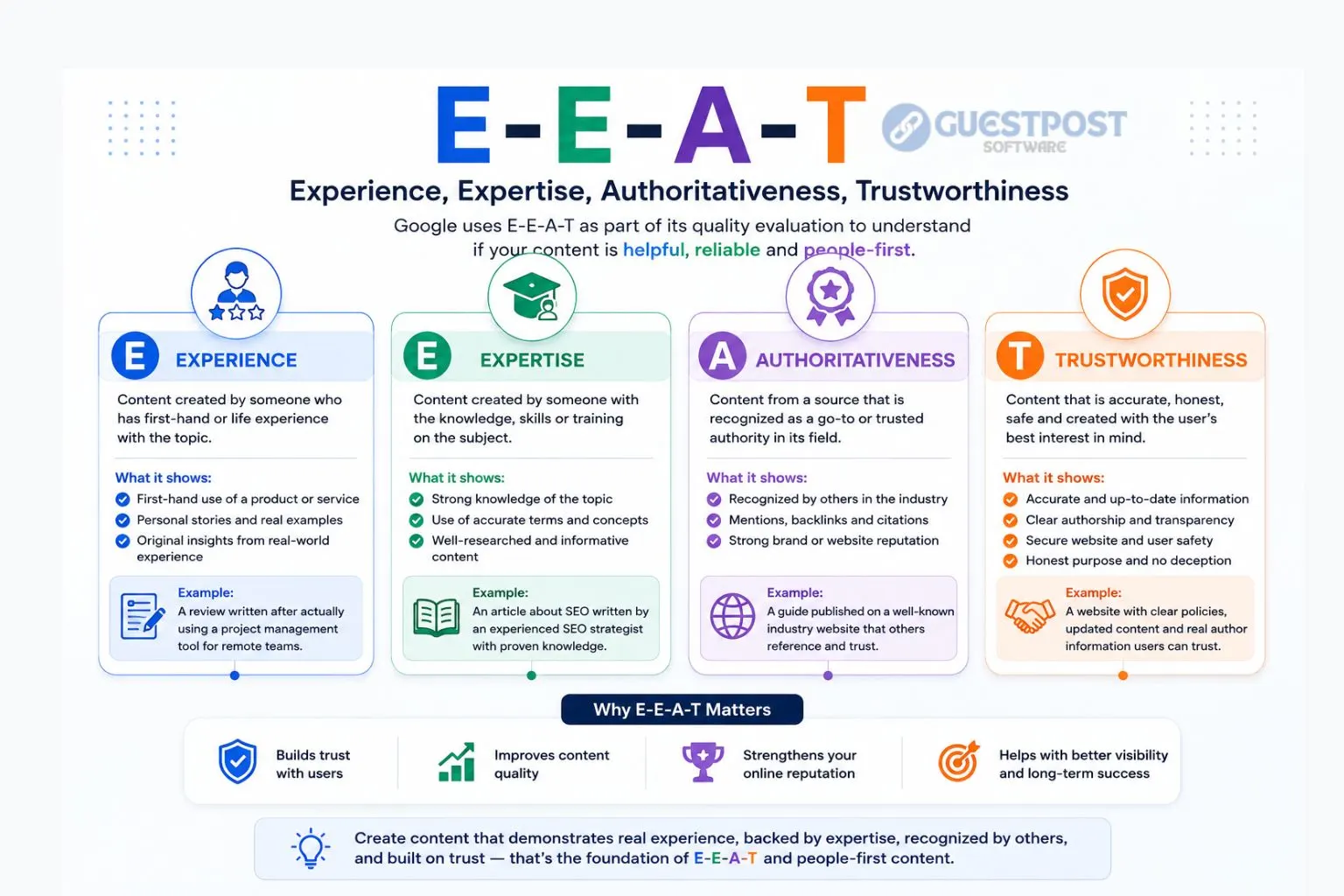
E-E-A-T stands for Experience, Expertise, Authoritativeness and Trustworthiness — concepts from Google's Search Quality Rater Guidelines used to describe content quality, not a numerical ranking score. A software review written by someone who actually used the product demonstrates first-hand Experience in a way a generic, aggregated article cannot.
Content, Authority & Off-Page
Backlink
A backlink is a link from another website to yours. Backlinks can signal relevance and trust, but quality, context and editorial intent matter far more than sheer quantity — more backlinks do not automatically mean better rankings, and manipulative link-building can do more harm than good.
Anchor Text
Anchor text is the clickable text of a link — branded (“GuestPost Software”), exact-match (“guest post pricing”), generic (“click here”), a naked URL, or natural contextual phrasing. Over-optimizing anchor text with the same exact-match phrase repeatedly can look manipulative rather than natural.
DA vs DR
Domain Authority (DA) is Moz's metric estimating how likely a site is to rank, calculated from a mix of link and site signals. Domain Rating (DR) is Ahrefs' comparative metric based specifically on backlink profile strength. Neither is a Google ranking score — both are third-party estimates useful for competitive comparison, not proof a page will rank.
Measurement & Performance
GSC — Google Search Console
Google Search Console is Google's free tool for monitoring search performance: clicks, impressions, ranking queries, indexing status and technical issues. It's essential for diagnosing why a page isn't ranking or getting clicks.
GA — Google Analytics
Google Analytics tracks what happens after someone reaches a site — behavior, conversions and acquisition sources. Search Console shows Google Search performance; Analytics shows what visitors do next.
KPI, ROI & CRO
A KPI is a metric tied to business goals — organic clicks, qualified leads, conversions or revenue, not rankings alone. ROI measures value gained relative to cost spent, though attribution is rarely as clean as a single number suggests. CRO is the practice of improving the percentage of visitors who complete an action, like registering or booking a demo — connecting SEO traffic to actual business outcomes.
Technical SEO Essentials
CMS, URL & XML Sitemap
A CMS, like WordPress, is software used to publish and manage web content; no CMS automatically ranks better than another. A URL is a page's address — /blog/seo-vocabulary-2026 is more descriptive than /page?id=4821. An XML sitemap lists a site's pages for search engines to discover, though submitting one doesn't guarantee indexing.
Robots.txt & Canonical Tags
Robots.txt gives crawling instructions, but blocking a page from crawling doesn't guarantee it's removed from Google's index — that requires separate steps. A canonical tag marks the preferred version among duplicate or similar URLs; it's a strong signal to search engines, not an absolute command.
Structured Data & Core Web Vitals
Structured data is machine-readable markup, built on Schema.org vocabulary, that helps search engines understand page content; it doesn't guarantee rich results or higher rankings. Core Web Vitals measure page experience: LCP (how fast the main content loads), INP (how quickly the page responds to interaction) and CLS (how much the layout shifts while loading).
AI Search Vocabulary for 2026
SEO vocabulary now overlaps heavily with generative AI and answer-oriented search — a shift that has reshaped how marketers think about visibility.
AEO — Answer Engine Optimization
AEO is an industry term for making content easy for answer-oriented systems to understand and surface — clear direct answers, question-based structure, entity clarity and well-organized supporting information. It isn't a documented Google ranking system, just an approach to answer-friendly content.
GEO — Generative Engine Optimization
GEO means Generative Engine Optimization, not geolocation SEO. It refers to visibility within generative AI search experiences. Traditional SEO drives search visibility, AEO drives answer visibility, and GEO drives generative visibility — but these overlap substantially, and strong technical SEO, original information and credibility remain the foundation for all three. No method guarantees an AI citation.
LLM — Large Language Model
An LLM is an AI model trained on large volumes of text to understand and generate language. Marketers increasingly encounter LLMs in search, content discovery, research tools and customer-facing chat experiences, though not every AI or search system works identically.
RAG — Retrieval-Augmented Generation
RAG describes an AI system retrieving relevant external information and using it as context when generating an answer. Someone researching “best project management software for remote teams” might get an AI answer built partly from retrieved articles and reviews — which is why clear, accessible, well-structured information can matter in these environments, though it doesn't guarantee citation or traffic.
SEO Terms to Stop Misusing in 2026
“LSI keywords” is an outdated, misleading way to describe modern SEO — there's no need to hunt for a list of “LSI keywords” to insert into an article. Focus instead on natural language, related entities, topic completeness and genuine search intent. Keyword density is similarly outdated; blindly targeting a percentage isn't a sound content strategy. And third-party scores like DA, DR or SEO-tool ratings should never be presented as a “Google ranking score” — Google doesn't publish one.
SEO vs AEO vs GEO
Factor | SEO | AEO | GEO |
Primary goal | Rank in organic search results | Be featured as a direct answer | Be surfaced/cited in AI-generated responses |
Typical environment | Google, Bing organic results | Featured snippets, voice, AI Overviews | Chatbots, AI Overviews, generative assistants |
Content approach | Keyword-aligned, comprehensive pages | Clear, direct, question-based answers | Well-structured, credible, entity-clear content |
Technical foundation | Crawling, indexing, Core Web Vitals | Structured data, clear headings | Same technical foundation as SEO/AEO |
Measurement | Rankings, organic traffic, GSC data | Snippet/featured placements | Still an evolving, imprecise measurement area |
Key limitation | Slower to show results | Limited answer space, no guarantees | No confirmed, guaranteed citation method |
How These Terms Work Together
Picture a SaaS company launching a project-management tool. It starts with search intent research, builds content around real queries, fixes technical SEO issues, earns backlinks through genuine digital PR, and gains SERP impressions. Strong titles improve CTR, driving traffic that CRO then converts into signups — tracked through KPIs and ROI. The same content, if genuinely useful and well-structured, may also surface in AI Overviews or get retrieved by an LLM through RAG, showing how classic SEO and AI-search visibility increasingly run through the same content.
Ready to place content on verified websites?
Browse verified editorial opportunities →Transparent publisher metrics and pricing on guestpostsoftware.com.
Share
About the author
Guestpost Software Editorial Team
Editorial and SEO insights from the Guestpost Software team—guest posting strategy, publisher relationships, and measurable content outcomes.
About Guestpost Software · Our editorial process · Help Center
Related posts
Continue reading

Do Media Outreach Still Work for SEO in 2026? A Data-Driven Guide
Practical guest posting and SEO guidance from Guestpost Software.

Benefits of Guest Posting in 2026–2027: What Still Works, What Does Not, and How to Measure Real Value
Practical guest posting and SEO guidance from Guestpost Software.
Guest Post Pricing: How to Evaluate Cost and Value in 2026
Practical guest posting and SEO guidance from Guestpost Software.
What Is AI-Powered Media Outreach Platform?
Practical guest posting and SEO guidance from Guestpost Software.

Media Outreaches: How much should you pay in the USA?
Practical guest posting and SEO guidance from Guestpost Software.

Media Outreach Platform and Media Outreach Agency
Practical guest posting and SEO guidance from Guestpost Software.