
Benefits of Guest Posting in 2026–2027: What Still Works, What Does Not, and How to Measure Real Value

The main benefits of guest posting in 2026–2027 are access to a relevant audience, qualified referral traffic, expert credibility, brand discovery, publisher relationships, durable content, and opportunities for natural citations and secondary coverage. Guest posting can also support legitimate search and AI-search vis…
The main benefits of guest posting in 2026–2027 are access to a relevant audience, qualified referral traffic, expert credibility, brand discovery, publisher relationships, durable content, and opportunities for natural citations and secondary coverage. Guest posting can also support legitimate search and AI-search visibility when the content is original, useful, publicly accessible, and policy-compliant. However, it does not guarantee rankings, leads, backlinks, or AI citations. Its real value depends on audience fit, editorial quality, distribution, brand safety, and measurement.
Information verified as of September 11, 2026. Expectations for 2027 are identified as informed analysis rather than confirmed outcomes.
Key takeaways
Guest posting works best as expert content distribution and relationship building—not as a purchase of ranking credit.
A specialist publication with a relevant audience can create more business value than an unrelated site with higher DA or DR.
Earned contributions, sponsored posts, paid placements, link insertions, and digital PR coverage are different arrangements with different disclosure, editorial, and measurement requirements.
Links created mainly to manipulate rankings can violate Google’s spam policies. Paid links should use
rel="sponsored";rel="nofollow"remains acceptable.Measure immediate actions, assisted business outcomes, brand signals, publisher relationships, search performance, and supported AI citations over different time horizons.
The Guest Post Opportunity Scorecard below is an editorial decision tool—not a Google-approved formula or ranking predictor.
In-article visual: Guestpost Software infographic. Upload the supplied WebP to the media library and replace the relative image path with its final media URL.
What guest posting means—and what it should not be confused with
Guest posting means publishing a substantive contribution on a website the contributor does not own. The host retains editorial responsibility while the contributor supplies useful expertise for its audience. For more context, see what guest posting is. Before measuring value, separate five arrangements:
Arrangement | Who controls publication? | Is payment involved? | Primary value | Compliance consideration |
|---|---|---|---|---|
Earned editorial contribution | Editor accepts, edits, and publishes on merit | Usually no placement fee | Audience, credibility, relationship, editorial citation | Links should remain genuinely editorial rather than negotiated ranking products |
Sponsored guest post | Publisher retains standards but sells a disclosed content opportunity | Yes | Audience access, content distribution, brand communication | Commercial nature should be disclosed; paid links should be qualified |
Paid content placement | Varies from a full editorial package to simple hosting | Yes | Depends on audience, editing, distribution, and reporting | Do not assume payment safely buys ranking credit |
Link insertion | A link is added to an existing page | Sometimes | Referral utility when the link genuinely improves the page | Paying primarily for ranking influence creates link-spam risk |
Digital PR coverage | Journalist, editor, or creator develops coverage using a newsworthy source or story | Not normally payment for the article itself | Earned awareness, mentions, citations, media validation | Coverage, wording, and links usually remain outside the brand’s control |
A sponsored article can be useful, and an earned contribution can be poor. Judge reader value, editorial integrity, transparency, and intended outcome.
What still works in 2026–2027
The durable model publishes useful expertise where the right people already spend attention. The article should solve a host-audience problem even without a click.
What still works includes original analysis, substantiated experience, research, datasets, templates, and decision tools shaped for the host audience. Strong programs also use accurate author credentials, transparent commercial relationships, helpful links, normal publisher distribution, continuing editor relationships, and measurement tied to audience or business outcomes.
Google’s people-first guidance asks whether content offers original information, substantial value, expertise, and bookmark or share potential. It also advises serving an intended audience instead of creating content mainly for search visits (Google Search Central).
What does not work—or creates fragile value
The weakest version treats an article as packaging around a purchased anchor. Warning signs include mass-produced copy, unrelated placements selected for metrics, mandatory exact-match anchors, guaranteed followed links, pages hidden from normal navigation, incompatible sponsored topics, invented authors, recycled content, missing disclosure, and reporting limited to “the link is live.”
Google defines link spam as creating links to or from a site primarily to manipulate search rankings. Its examples include exchanging money for links or posts containing links (Google Search spam policies). Google also states that third-party content is not automatically site reputation abuse; the issue arises when it is published mainly to exploit the host site’s established ranking signals (Google’s site reputation policy).
Twelve meaningful benefits of guest posting
1. Reach an established and relevant audience
A credible publication has already attracted readers around a subject. A useful contribution gives an expert access to that context without building a new audience from zero. Raw reach is not the goal: a smaller readership interested in corporate compliance, electric vehicles, or B2B software can be more valuable than a large unrelated audience.
2. Generate qualified referral traffic
Readers who click after receiving a detailed answer arrive with useful context. Link to a closely matched resource or next step and use UTM parameters when the publisher permits them. Google Analytics documents that tagged destination URLs can identify referring campaigns in its Traffic acquisition report (Google Analytics).
3. Build expert credibility and thought leadership
A byline alone proves little. Credibility grows when a contribution makes a defensible argument, cites primary evidence, explains tradeoffs, and accurately identifies the author’s background. A portfolio of substantive work can later help customers, partners, journalists, and event organizers validate expertise.
4. Increase brand discovery
Some readers will remember a name or search for it later without clicking immediately. Monitor branded searches, direct visits, mentions, and relevant followers, but account for other campaigns before attributing a change to one article.
5. Strengthen relationships with editors and publishers
Contributors build trust by proposing relevant ideas, meeting standards, responding to edits, and delivering accurate copy. Track repeat invitations, expert-quote requests, commissions, response rates, and access to new distribution channels as evidence of relationship value.
6. Distribute original research, insights, and useful resources
Guest contributions can translate a report, benchmark, framework, or field observation for a publication’s readers. Give them a complete answer, then link to a dataset, methodology, tool, or expanded guide where helpful; do not withhold the answer simply to force a click.
7. Create opportunities for natural citations and secondary coverage
Journalists, analysts, educators, and publishers need reliable sources. A clear method, original finding, useful chart, or precise definition may earn later references. Secondary coverage is a possible result of reference-worthy work, not a deliverable that can be guaranteed.
8. Support sales conversations and reputation validation
A relevant article can demonstrate how a company thinks before a prospect replies, books, or buys. Sales teams can use it in proposals and follow-ups when it answers the buyer’s problem. Track asset usage and influenced opportunities, but do not claim causation without sufficient evidence.
9. Learn which topics resonate with potential customers
Editorial feedback, article engagement, reader questions, and referral behavior reveal which problems deserve deeper coverage. Feed those signals into webinars, product guides, FAQs, and sales material; a post that produces few clicks but valuable questions can still inform strategy.
10. Create evergreen content value
A useful article can continue attracting discovery through search, internal links, newsletters, reshares, and direct references. Longevity remains conditional, so confirm archive, update, and removal terms and periodically check that the URL remains accessible.
11. Support legitimate search visibility
Google says its ranking systems use many signals, work mainly at page level, and include link analysis among numerous systems (Google Search ranking systems). A guest-posting strategy should not depend on paid links passing ranking credit.
“Topical authority” is SEO shorthand for sustained depth, relevance, expertise, and useful subject coverage. Google does not publicly identify it as a standalone metric or named ranking system. Use it as a planning concept, not a score that placements can purchase.
Google asks publishers to mark advertising or paid-placement links with rel="sponsored"; rel="nofollow" remains acceptable (Google Search Central). Paid publication can buy legitimate audience and content services, but marketers should not imply that its links safely transfer ranking credit.
12. Increase the possibility of discovery in AI-generated answers
Public expert content gives search and AI systems additional information to discover. Clear definitions, named entities, structured sections, original evidence, dates, and citations can improve comprehensibility—but cannot guarantee selection.
Bing’s AI Performance public preview reports citations, cited pages, sampled grounding queries, URL activity, and trends across supported Microsoft experiences. Bing cautions that citation counts do not indicate ranking, authority, or a page’s role in an answer (Bing Webmaster Blog). Google says ordinary Search foundations apply to its AI features and no special optimization is required (Google Search Central). Guest posting cannot guarantee inclusion in ChatGPT, Gemini, Copilot, Google AI Overviews, Perplexity, Claude, or another system.
Informed analysis for 2027: measurement will likely improve as more citation and referral data becomes available, while generic third-party content may face stronger quality filtering. These are not confirmed platform roadmaps.
Guest-posting benefits, KPIs, and realistic timeframes
These are measurement windows, not promises; results depend on distribution, audience, buying cycle, indexing, and quality.
Potential benefit | How it is created | Recommended KPI | Expected timeframe | Common limitation |
|---|---|---|---|---|
Relevant audience reach | Publication in a closely matched editorial channel | Article views or publisher-reported reach | Launch week to 30 days | Publisher data may be unavailable or estimated |
Qualified referral traffic | Useful contextual path to a relevant destination page | Referral sessions and engaged-session rate | Immediate to 90 days | Low volume can still be high quality |
Lead generation | Clear next step matched to reader intent | Registrations, enquiries, key events, conversion rate | Days to several months | Last-click reporting may miss influence |
Credibility | Evidence-rich article and credible author identity | Sales usage, profile visits, invitations, qualitative feedback | Weeks to months | Difficult to isolate causally |
Brand discovery | Repeated exposure to the brand or expert | Branded searches, mentions, direct traffic | Days to months | Other campaigns affect the same signals |
Publisher relationships | Reliable delivery and editorial cooperation | Repeat invitations and acceptance rate | One to twelve months | Relationship quality is partly qualitative |
Natural citations | Original, reference-worthy information | Unlinked mentions and secondary earned links | Weeks to years | Cannot be guaranteed |
Evergreen value | Durable, updated, internally discoverable article | Ongoing views, referrals, mentions, page availability | Months to years | Publisher may archive, remove, or stop maintaining it |
Search visibility | Helpful content and editorially appropriate linking | Search Console clicks, impressions, queries, and landing pages | Several weeks onward | Rankings fluctuate and attribution is shared |
AI-answer discovery | Accessible, clear, well-sourced public information | Bing AI citations and grounding queries where available | Uncertain; monitor monthly | Coverage is partial and platform-specific |
Why relevance can beat a higher DA or DR
Domain Authority and Domain Rating are third-party metrics. Neither proves that the right readers will see an article, the publisher has editorial integrity, or distribution will occur.
Consider a cybersecurity consultancy choosing between two publications:
A broad lifestyle site with a higher third-party authority score but no security audience
A smaller security operations publication read by practitioners and technology buyers
The specialist site may produce fewer visits but more engaged readers, relevant enquiries, invitations, and sales validation. Value is not “cost per DA point”; it is useful exposure and action among intended readers.
When money is involved, evaluate guest post pricing as a package of editorial work, audience access, distribution, reporting, rights, and compliance—not as a price for an unqualified link.
Bookmarkable Guest Post Opportunity Scorecard
Score each factor from 0 to 2:
0: missing, poor, unsafe, or unverifiable
1: acceptable but incomplete, uncertain, or conditional
2: strong, relevant, transparent, and verifiable
Factor | 0 points | 1 point | 2 points |
|---|---|---|---|
Audience relevance | Audience is unrelated | Partial overlap | Clear fit with target readers or buyers |
Real readership and traffic quality | No credible evidence or suspicious sources | Some evidence but limited clarity | Consistent relevant readership with credible traffic patterns |
Editorial standards | Automatic acceptance or visibly weak content | Basic review | Clear guidelines, substantive editing, accurate recent work |
Content originality | Duplicate, spun, or generic material common | Mixed quality | Original reporting, analysis, expertise, or research expected |
Publisher transparency | Ownership and contact details hidden | Partial information | Clear organization, contacts, authors, and policies |
Distribution opportunities | Article is merely hosted | Category placement only | Normal category visibility plus newsletter, social, homepage, or community reach |
Link and sponsorship compliance | Manipulative anchors or unqualified paid links required | Policy unclear | Disclosure and link treatment documented |
Brand safety | Harmful, deceptive, or incompatible content present | Some mixed-topic risk | Consistent subject, credible advertisers, and suitable editorial environment |
Measurement capability | No trackable link or reporting | Basic analytics possible | UTM support, first-party reporting, and agreed KPIs |
Long-term content accessibility | Removal likely or terms absent | Availability uncertain | Stable URL, archive policy, and removal/update terms documented |
Maximum score: 20.
16–20: Strong candidate, subject to cost, legal, and final editorial review
11–15: Conditional opportunity; resolve weak factors before committing
0–10: High uncertainty or weak value; usually decline or investigate further
This scorecard is an editorial planning framework—not a Google-approved formula, ranking factor, penalty test, or performance guarantee. One serious security, deception, or compliance issue can justify rejection regardless of score.
Publisher-security and brand-safety checklist
Before submitting content or paying a fee, check:
HTTPS and security: No certificate errors or mixed-content warnings.
Malware and redirects: No deceptive redirects, forced downloads, or browser warnings on desktop or mobile.
Ownership: Identifiable organization, working contacts, and legal or editorial pages.
Domain history: No unexplained switch in subject, language, ownership, or publishing volume.
Authors and policies: Plausible contributors plus editorial, correction, and commercial-content standards.
Sponsored-content pattern: No rapid flow of unrelated casino, loan, supplement, software, and travel posts.
PBN indicators: No cloned designs, repeated content, shared schemes, fake profiles, or absent readership.
Anchor requirements: No mandatory commercial exact-match anchor or followed-link promise.
Traffic quality: Plausible geography, landing pages, engagement, and trend history—not one estimate.
Indexing and activity: Recent articles are accessible, discoverable, and linked from normal sections.
Removal terms: Update, archive, ownership, duration, and remedy conditions are documented.
Disclosure and link treatment: Sponsorship labels and paid-link attributes are agreed in advance.
For content quality itself, write a guest post editors will approve by centering the host audience, a defensible angle, useful evidence, and the publication’s editorial requirements.
A practical measurement framework
One metric cannot represent guest-posting value. Record the publisher, topic, audience, objective, final and destination URLs, date, cost, disclosure, link attribute, distribution commitments, and review windows for every placement.
Configure tracking before publication
Use a consistent UTM convention when permitted, for example:
utm_source=publishername&utm_medium=referral&utm_campaign=guest_post_2026&utm_content=article_topic
Respect publisher rules and avoid exposing sensitive campaign information. Test the destination, analytics, consent behavior, and key events before launch.
Measure in four layers
Measurement layer | Metrics | What it tells you |
|---|---|---|
Direct response | Referral sessions, engaged sessions, newsletter registrations, enquiries, key events, conversions | Whether readers arrived and took an observable action |
Assisted business impact | Assisted conversions, influenced opportunities, sales-team usage, conversion lag | Whether the article contributed before a later conversion |
Brand and earned distribution | Branded searches, social shares and saves, unlinked mentions, naturally earned secondary links | Whether awareness or reference value spread beyond the original page |
Relationship and discovery | Repeat publisher invitations, Search Console performance, Bing Webmaster Tools AI citation reporting where available | Whether the asset created continuing editorial, search, or supported AI visibility |
Google Analytics defines an engaged session as one lasting longer than 10 seconds, containing a key event, or producing at least two page or screen views (Google Analytics Help). Interpret it alongside page purpose and conversion cycle.
In Search Console, monitor landing-page impressions, clicks, queries, countries, and trends without assigning every change to one article. Google documents how Performance-report clicks and impressions are counted (Search Console Help).
Where available, record Bing citation trends, cited URLs, and sampled grounding queries. These are not rankings or cross-platform totals.
Use appropriate review windows
0–30 days: distribution, referral and engaged sessions, registrations, enquiries, saves, and shares
31–90 days: assisted conversions, branded searches, sales usage, Search Console trends, and mentions
Quarterly: evergreen referrals, publisher invitations, page status, natural citations, and available Bing AI data
Annually: portfolio quality, cost per meaningful outcome, relationships, updates, and removals
Separate outcomes into three columns: measured, inferred, and unconfirmed. This prevents a plausible influence—such as a prospect seeing an article before booking—from being presented as proven attribution.
What guest posting cannot fix
Guest posting cannot repair fundamentals that fail after the reader arrives.
A weak product: Editorial exposure cannot create durable demand for an unreliable or poorly differentiated offer.
A poor website experience: Slow pages, intrusive design, unclear navigation, security warnings, and broken forms waste qualified visits.
Thin destination pages: A contextual link cannot help readers if the landing page lacks evidence, answers, or a logical next step.
Technical SEO problems: Crawling, indexing, canonicalization, rendering, mobile usability, and internal-link issues require technical fixes.
Unclear positioning: Readers cannot remember or recommend a brand when its audience, problem, and value proposition are vague.
Unsuitable publisher selection: Excellent writing cannot create audience fit on a publication whose readers do not need the subject.
Fix these problems before scaling placements.
How to make a guest post worth sharing and bookmarking
The standard is not “good enough to publish.” It is “useful enough to return to.”
Solve a specific audience problem for a clearly defined reader and decision.
Add original experience or analysis explaining what changed and why it matters.
Include a practical framework such as a scorecard, worksheet, or process.
Use verifiable examples and label hypothetical illustrations.
Provide a checklist or template readers can apply later.
Cite primary sources close to the claims they support.
Use clear headings and concise definitions for fast reference.
Update time-sensitive information with a visible verification or modified date.
Avoid excessive promotion; keep the bio and CTA restrained.
These practices also help editors assess quality quickly. If managing research and publication across multiple outlets, an AI-powered media outreach platform may support discovery and workflow, but software does not replace editorial judgment or compliance review.
Google and FTC rules: the practical version
Google’s policies focus on manipulation and proper link qualification:
Links created primarily to manipulate rankings can violate Google’s spam policies.
Payment for a post does not make a followed link safe for ranking purposes.
Advertising and paid-placement links should use
rel="sponsored";rel="nofollow"remains acceptable.Original, helpful, reliable, people-first content should remain the priority.
Publishing third-party content is not automatically site reputation abuse, but using a host mainly for its established ranking signals can violate policy.
Search compliance and advertising disclosure are separate. FTC guidance says advertising should not appear to be independent editorial content. Necessary disclosures should be clear and prominent; near-headline placement may suit article-style native advertising (Federal Trade Commission). Updated Endorsement Guides also address material connections between advertisers and endorsers (FTC, June 2023).
Disclosure requirements vary by facts and jurisdiction. Obtain legal advice for regulated products, endorsements, comparative claims, or multi-country campaigns.
A better decision: value first, link second
Guest posting remains useful when it carries expertise to the right readers, teaches something specific, survives editorial review, and produces measurable evidence.
Use the scorecard before approving a publisher. Set KPIs before publication. Treat paid links correctly. Then review audience behavior, relationships, business influence, search performance, and supported AI citations without turning correlation into certainty.
If you are planning a campaign, bookmark this checklist and share it with the people responsible for content, PR, SEO, analytics, and compliance. When you are ready to compare opportunities, you can browse guest post sites by niche, country, traffic, metrics, and pricing—then apply the same editorial and brand-safety checks before committing.
Ready to place content on verified websites?
Browse verified editorial opportunities →Transparent publisher metrics and pricing on guestpostsoftware.com.
Share
About the author
Riya Singh
Editorial and SEO insights from the Guestpost Software team—guest posting strategy, publisher relationships, and measurable content outcomes.
About Guestpost Software · Our editorial process · Help Center
Related posts
Continue reading
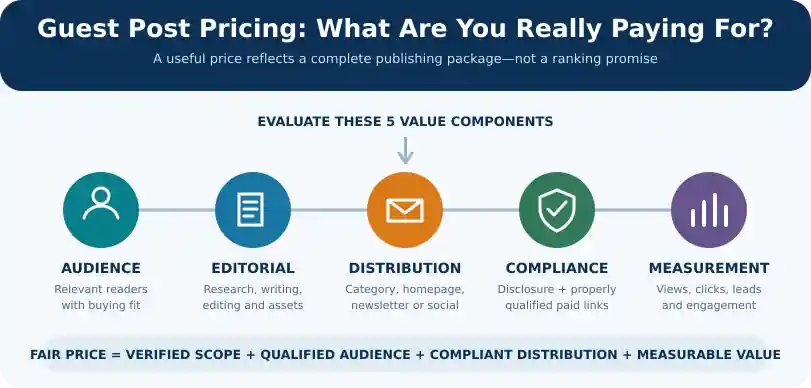
Guest Post Pricing: How to Evaluate Cost and Value in 2026
Practical guest posting and SEO guidance from Guestpost Software.

What Is AI-Powered Media Outreach Platform?
Practical guest posting and SEO guidance from Guestpost Software.

Media Outreaches: How much should you pay in the USA?
Practical guest posting and SEO guidance from Guestpost Software.

Media Outreach Platform and Media Outreach Agency
Practical guest posting and SEO guidance from Guestpost Software.

Best Media Outreach Platforms in the USA (2026)
Practical guest posting and SEO guidance from Guestpost Software.
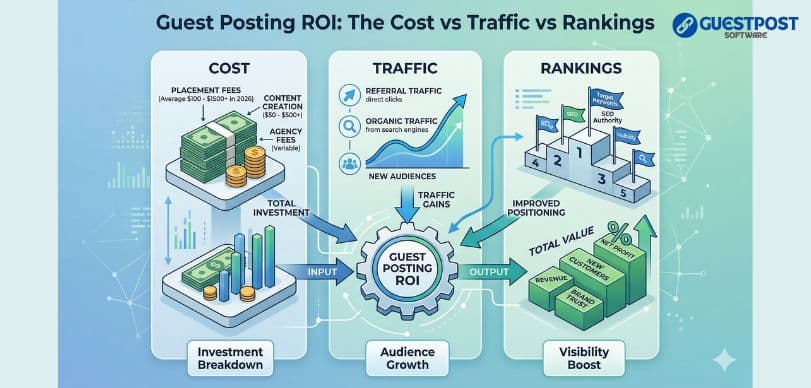
Media Outreach ROI: The Cost vs Traffic vs Rankings
Practical guest posting and SEO guidance from Guestpost Software.